
Yes, there are cases when it is perfectly ok to surf without a leash. But the devil is in the details. Who, what, and when matter. Who is the surfer and how long have they been surfing? What are the waves, weather, ocean, and crowd conditions like? What is the context? Are we talking about a longboard competition, surfing gnarly Teahupoo or Pipeline, shortboard ripping in punchy, fun waves, or a hipster trying to pretend he's Joel Tudor leashless and masterful on a classic log two weeks out of his first surf lesson? In this blog post I will break down the nuances of who should surf with a leash and who should not and in what what contexts. I will proceed as follows:
Framing the leash debate – Law at Byron Bay, Jack Oneill, Surf Karens online, Pipe and Teahupoo, posers
When it's ok to surf without a leash – experts in small waves, experts in big waves, pro level longboarders in lots of wave sizes, beginners learning board control w/out a crowd, surfing shorebreaks
When you should surf with a leash – most conditions for anyone who has not mastered board control, consistent, medium sized surf, lots of rock hazards near shore, super crowded lineups, whenever you are learning a technique that requires you to fall a lot
Complete guide to leashes – anatomy, recommended lengths and thicknesses, calf vs ankle cuff, how to tie the leash strings, double uses
Leash care
General safety recommendations repeated
Summary of the article and an insider tip about never retrieving the board of an expert who is surfing w/out a leash
Framing the Leash Debate
I will put my cards on the table up front: I hate wearing a leash. It creates drag. It gets tangled in my feet. And I love the feeling of just me and my board flying along the wave. Plus I have excellent, pro level board control, which means that I don't need to wear a leash in all sub-pumping surf conditions. Does that mean I never wear a leash when I surf? Not by a long shot. I know exactly the difference between conditions that require me to wear a leash and those that do not. In all of my sessions surfing without a leash I have never once hit another surfer with my board. In fact, I have not hit another surfer with my board, leash or no leash, since the one time a did a cutback into a middle aged man's shins at Pleasure Point when I was 12 years old. He held my head under water two times and then threw me away like a piece of trash. His response was wrong – he could have just told me that burning a person and doing a cutback into their shins is not ok – but that was the first and last time I hit another surfer with my board, and I was wearing a leash.
In 2023 a "leash law" passed in the Byron Shire in New South Wales, Australia making leash wearing mandatory at the famous sand point called "The Pass." There are now fines up to $1100 ASD for not wearing a leash. This law was sparked by a near-fatal incident when a surfer had an artery severed after he was hit by a stray board. But guess what? The board hit him because the owner's leash broke not because he wasn't wearing a leash. A leash did, however, come in handy here: they used someone else's leash to tie a tourniquet, which helped save the surfer's life. There are a handful of people who think this law is a great idea (including the man who was hit by the board), and a much larger percentage who think it's going to do very little to make surfing safer in Byron and elsewhere. One of those surfers is Lauryn Hill. She makes her case in this excellent piece on Patagonia's Australian blog.
I basically 100% agree with Hill, but I did not know that surf schools were teaching people to "avoid their boards at all costs." That's frightening. I thought the multi stage pop ups were bad enough — I didn't even know that some schools are teaching people to ditch their boards. Yikes. That's "leash abuse" of the highest order.
On another side of the debate high performance surfers like Maui's Albee Layer think that surfing without a leash makes you surf so conservatively that it takes all the fun out of high performance surfing, and that it signals to other surfers that you don't care about their safety. Wait a minute there. That can only be the case if you're both surfing recklessly and not wearing a leash. Layer is partially correct on his first point: surfing without a leash, when you're already a proficient surfer, often makes you surf conservatively, and for a surfer like Layer who wants to push the limits of his surfing at all times, surfing conservatively is not fun. Fine. But it doesn't mean that a proficient surfer without a leash is signaling lack of care to his fellow surfers. He could be signaling, "I care about you so much that I'm going to control my board this whole session in which I'm also not wearing my leash." It would be his conservative surfing that is keeping himself and others safe, and not wearing a leash is reinforcing that kind of surfing. That might not be Layer's cup of tea, but it might be someone else's. I also don't think that Layer has much interest in surfing the sorts of waves in which wearing a leash is more hassle than it's worth: small, gutless waves that won't allow you to do high performance moves in the first place.
Then there's the fact, pointed out elegantly by Hill, that leashes can cause more danger than they prevent. Surfers like Jack O'neill and Derek Hynd have lost eyes due to the leash whipping the board back at their faces. I've also almost lost my eye for the same reason (see the opening photo in my article Is Surfing Dangerous?). Leashes can hog tie you under water, become caught on objects like piers, jetties, and reefs, and wrap around various body parts — I've seen my best friend go over the falls with the leash in his mouth (I honestly do not know how that even happened)! And worst of all they can provide a false sense of security. Just because you're attached to your board, doesn't mean your board can't still hit people. Most people who are hurt by other peoples' equipment are hurt by people who are wearing leashes. And, as the incident at The Pass proves, there is no guarantee that your leash or leash string will stay intact at all times. Leashes break. If you aren't a very strong swimmer and you're relying on a board for flotation and your leash breaks, you could be in a lot of trouble getting back to shore. Neither board nor leash should make up for lack of basic swimming and ocean awareness skills.
And then we have the online Karens commenting on videos like those in my Mastering A Midlength Series that me not wearing a leash "ruins" the video for them. The only thing that can ruin the video for you is you and your own taste. The surfing is solid. I'm not losing my board. I do not got surfing without a leash if I think there is the remotest chance I won't be able to control my surfboard. Also, when did these people become authorities in surfing? After their third year at a camp in Costa Rica? Surfing culture is hierarchical based upon ability level. It's that simple. Access to different ways of riding are achievements. The good news is that most of us welcome more great surfers who control their equipment and share waves. All of my output is meant to communicate this one fact very clearly: simple surfing with impeccable board control is radical and achievable.
Lastly, the issue is complicated by the fact that expert surfers, especially longboarders, prefer surfing without a leash because it's better for noseriding. These surfers create a paradigm of "cool" — a laid back demeanor, old school longboard, hip clothing, no leashes, ever — that is aspirational and imitable. Newer surfers attracted to this style of surfing and its attendant aesthetics will mimic their heroes and eschew leashes in an effort to "get the look" before they have developed the surfing ability to warrant not wearing a leash, especially in crowded conditions. The shortboard version of this is people who buy Slater Designs boards thinking they're gonna surf like Slater, and they can't yet even do a cutback on a mid length or longer board. I have seen both versions of this heinous posing, as it's quite prevalent in New York surfing culture, which is often more about image than it is about fundamentally solid surfing. Or there's a series of category errors regarding the steps required to achieve fundamentally solid surfing.
While the debates rage on, who do I think should get to surf without a leash and in what conditions?
When It's Ok To Surf Without A Leash
It's perfectly fine for expert surfers to surf without a leash in small, uncrowded waves. It's also fine for expert surfers to surf without a leash in small waves, regardless of crowd. It's just extra ok if there's no crowd. What do I mean by expert surfer? Someone with impeccable board control. And I mean impeccable. There is no border case. Impeccable is the bar. If you're still unclear about this read my article What Level Surfer Am I?. What do I mean by small waves? Anything from 6" to 3ft on the face, and generally soft or mushy. These sorts of waves do not offer much in the way of high performance, so the likelihood of falling is extremely low and rare.
Beginners and intermediates should practice surfing without a leash in small, relatively empty conditions. This will make them more mindful of their surfboard at all times and get them to impeccable board control faster than if they were to never practice surfing without a leash.
Big wave surfers surfing heavy waves like Pipe and Teauhupoo may want to opt for not wearing a leash. What? Yeah it seems counterintuitive, but think about it. First, if you fall you're probably going to break your board or your leash anyhow. Second, if you fall you want your board to be as far away from you as possible while you're getting absolutely destroyed by the wave. Third, it raises the stakes a little so that you're not going to send it on waves that you might not make. This is conservatism working in your favor — you're only going on waves that give you a 90%+ chance of making it. Also, no one, and I mean no one, is going to be sitting on the inside. All this said, there are still reasons people may want to opt for a leash in the same conditions. I don't think this one is as polarizing because just being out in those conditions is insane, leash or no leash.
Various levels of surfers surfing complete shorebreak. If the wave is breaking one foot from shore, you don't need a leash. The board is not going to hit anyone because when and if you wipeout you'll already be on or near the sand.
There exist some surf cultures, like in San Diego, CA, where wearing a leash is frowned upon for people on longboards, mid lengths, and retro style boards like fishes (interestingly all good if you're on a shortboard). Still, you need to be an expert surfer to go without the cord, so you're just going to have to deal with the shame if you're still not an expert. If you are an expert on anything but a standard shortboard, don't wear a leash in these surf cultures. You'll have an easier time socially.
If you're competing in a professional longboard competition like the Vans Duct Tape Invitational which has a rule against competitors wearing leashes.
When You Should Absolutely Wear A Leash
Whenever the waves are such that you know you're capable of pushing your level. You don't need to be reckless, per se, but in order to get better at surfing you need to try new things and fall. Here's where Layer is absolutely right: it would be more boring to surf in these sorts of conditions and worry the whole time about losing your board. For me this is anything above 3ft and a little punchy. Doesn't matter crowd size. I want more reps in fun waves and losing my board is not only going to be dangerous if there's a crowd, it's also going to limit my wave count. No brainer.
If you have anything less than impeccable board control, the waves are over 2ft, and there are more than 3-5 other humans in the water. This is still not cause for you to ditch your board or behave recklessly. Surf as though you're not wearing a leash, but do wear one.
When you're surfing near a super rocky coastline, reef, or at a beach with very strong sideways and outgoing rip currents. Really any break with strong currents it's absolutely careless to surf without a leash. Just one mistake and you and your board could be swept out to sea and not even together. Rocky coastlines the stakes are higher for obvious reasons. Lose your board and it's off to the ding repair man. If you are a pro longboarder and your home spot is a cobblestone reef like San Onofre, well, you know what the stakes are. Your dings are on you.
In large surf when you're likely to fall. I know this is contradictory to what I said above, but not really when you look at it. Your leash won't necessarily save you or your board, but it may give some surfers more confidence. In general, if you plan to surf big waves you need to be prepared to have all your equipment broken or stripped from you. That said, if you're a surfer for whom the leash brings more confidence in big surf, wear your leash. I would say it's especially helpful to wear a leash in conditions where you may not be able to duck dive every closeout set or where it could be possible that you do need to ditch your board (this does happen and you look for others behind you before doing so).
Probably if you're surfing in a shortboard competition. It'd be pretty gutsy to risk losing time to chase your board if you fell on a maneuver. And doubly gutsy to have the confidence that you're going to pull everything you go for. I believe it would make most people far too anxious, but I have seen cases, like in very small Huntington Beach, where the pro shortboarders were not wearing leashes. The norm, however, is that they wear leashes.
If you’re surfing The Pass in Byron Bay! Or any other surfing culture in which you’ll either receive a fine or a headache for surfing without a leash.
Complete Guide To Leashes
Let's get one thing absolutely straight, if you surf you're going to own multiple leashes. You'll own multiple boards of different lengths and you'll want different leashes for each. When you start out you'll just have one board and one leash, and this will eventually change.
Leash Anatomy
Cord
Made of urethane (also called polyurethane)
Stretches enough to absorb a hard pull without snapping, without stretching so much the board rockets back at you
Standard lengths: roughly 4 ft to 12 ft
Standard thicknesses: 3/16", 1/4", 5/16", up to 5/8" for big-wave leashes
Conventional wisdom: longer/thicker for bigger boards and bigger waves, shorter/thinner for performance and small surf
My take: go shorter, not longer. All leashes stretch over time — my 5ft leashes become 7ft, my 6ft become 8ft. More board plus more leash equals more danger. Here's how I actually size it:
Boards under 7ft: size down. Most boards 7ft and under, run a 6ft leash.
7'8" boards: either a 7ft or an 8ft leash works — not strict here. If you have to pick one, go shorter, because of stretch.
8ft boards: 8ft leash.
9ft and above: 9ft leash is standard. You can get away with an 8ft leash if you're not nose riding yet.
Nose riders: exception to all of this — if you're nose riding properly, you shouldn't be wearing a leash at all.
On thickness: a heavier board can tug hard enough to snap a thin leash, so go slightly thicker if your board has some weight to it. That said, you can still run a thinner leash on a heavier board if you want the freedom — just know that's the tradeoff you're making.
Cuff
Padded strap around ankle or calf — nylon webbing, neoprene, velcro closure
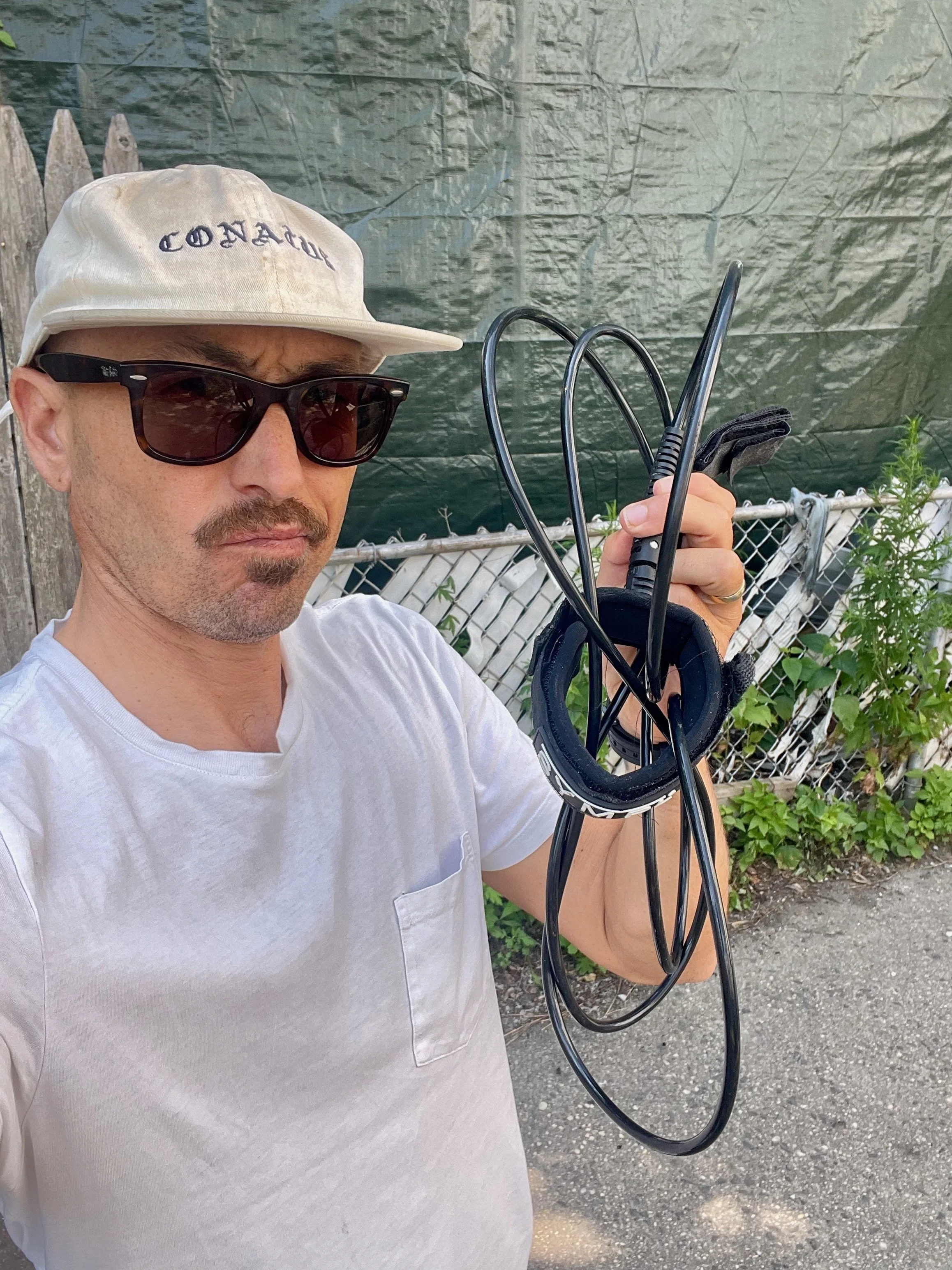
My take: ankle cuff is the default, full stop. Calf cuffs have exactly one legitimate use case — nose riding at crowded breaks, or longboarders in big waves who want to nose ride. Outside of that, they're pointless and they look bad. If you're not nose riding, you don't need one. And if you're nose riding properly, you shouldn't be wearing a leash at all.
Swivel(s)
Joint(s) connecting cord to cuff, and on some leashes, cord to rail saver
Function: lets the leash rotate freely so it doesn't twist into knots
Single swivel = cuff only. Double swivel = cuff + rail saver.
My take: no strong opinion here beyond noting this is another point where a leash can fail.
Rail saver
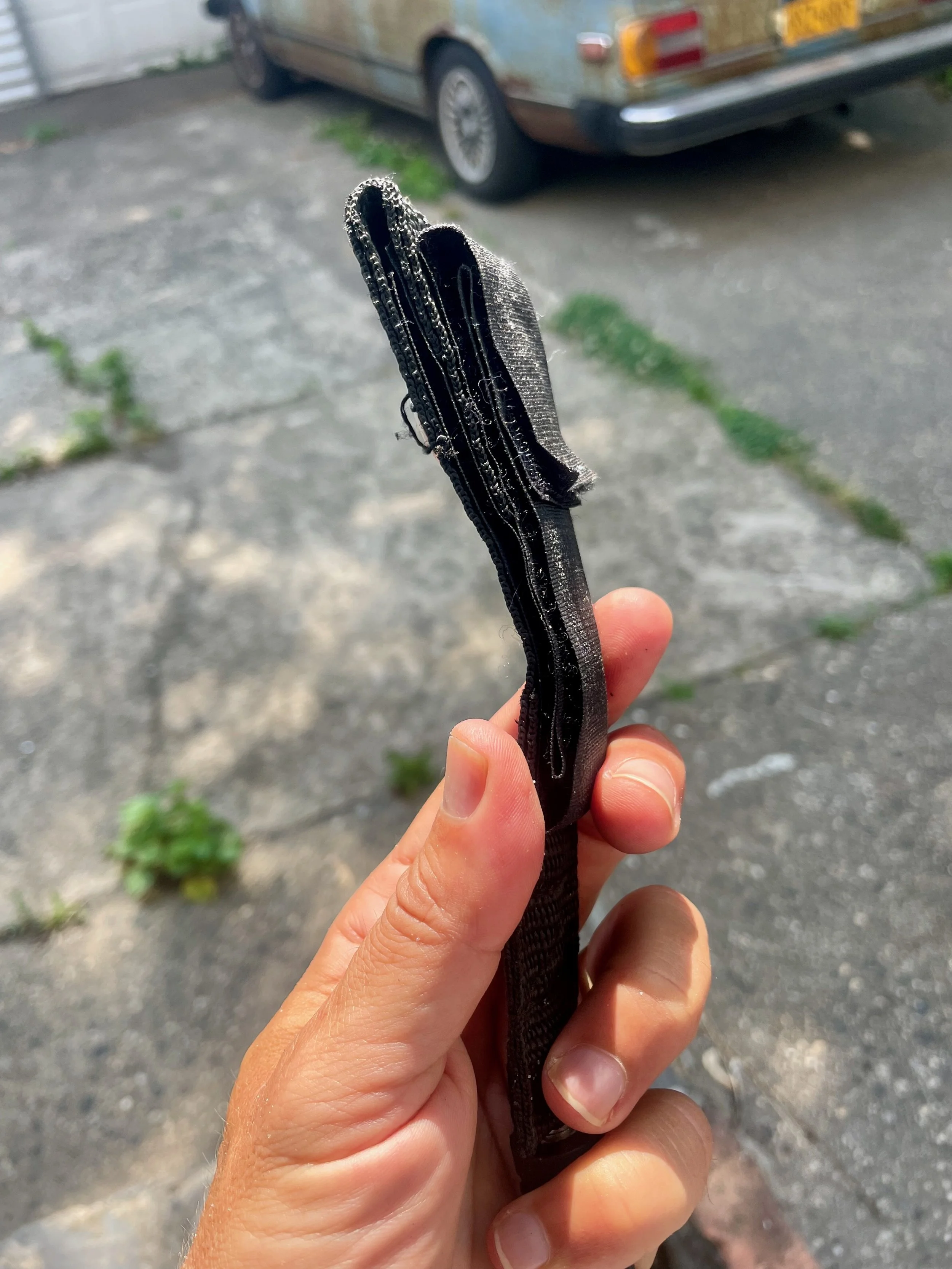
Wide, soft fabric strip between swivel and leash string
Function: spreads load so the cord doesn't cut into the board's rail
My take: this is a spot where I see a lot of newer surfers get it wrong, and it matters more than they realize. The leash string forms a loop (or two loops, depending on your plug setup) that the rail saver is supposed to run all the way through. What people actually do is just fold the rail saver's velcro over on itself — one level of stick — without ever threading it through the entire rail saver — the velcro is a sandwich you need the string(s) connected completely at that little canvas joint. If not, it looks attached and it isn't, not really. That's a weak connection dressed up as a strong one, and it's exactly the kind of stupid, avoidable error that costs you your board. How you attach your rail saver is not a minor detail — get this part right.
Leash string + plug
Small nylon string loop tying rail saver to the leash plug in the tail
Along with the cord, this is one of the two parts most likely to actually break mid-session
Two ways it attaches, depending on your fin setup:
Bahne box (single fin box): there's a small hole in the box running to the deck. Tie the string into a loop, push it through the deck of the board, and let the knot catch inside the box. Keep the loop small so it doesn't cut through the rail. Fishing line or sewing string with a needle can help thread it — or work it in with a fin Allen key or flathead screwdriver.
Leash plug (most boards with FCS, Futures, or glass-on fins — no Bahne box): the plug has a small metal bar. Have your loop ready-made, slide the non-knot end through, and pass the rail saver through the doubled loop. This keeps the rail saver close to the board, and makes it easy to pull the string out and reuse it on another board if needed.
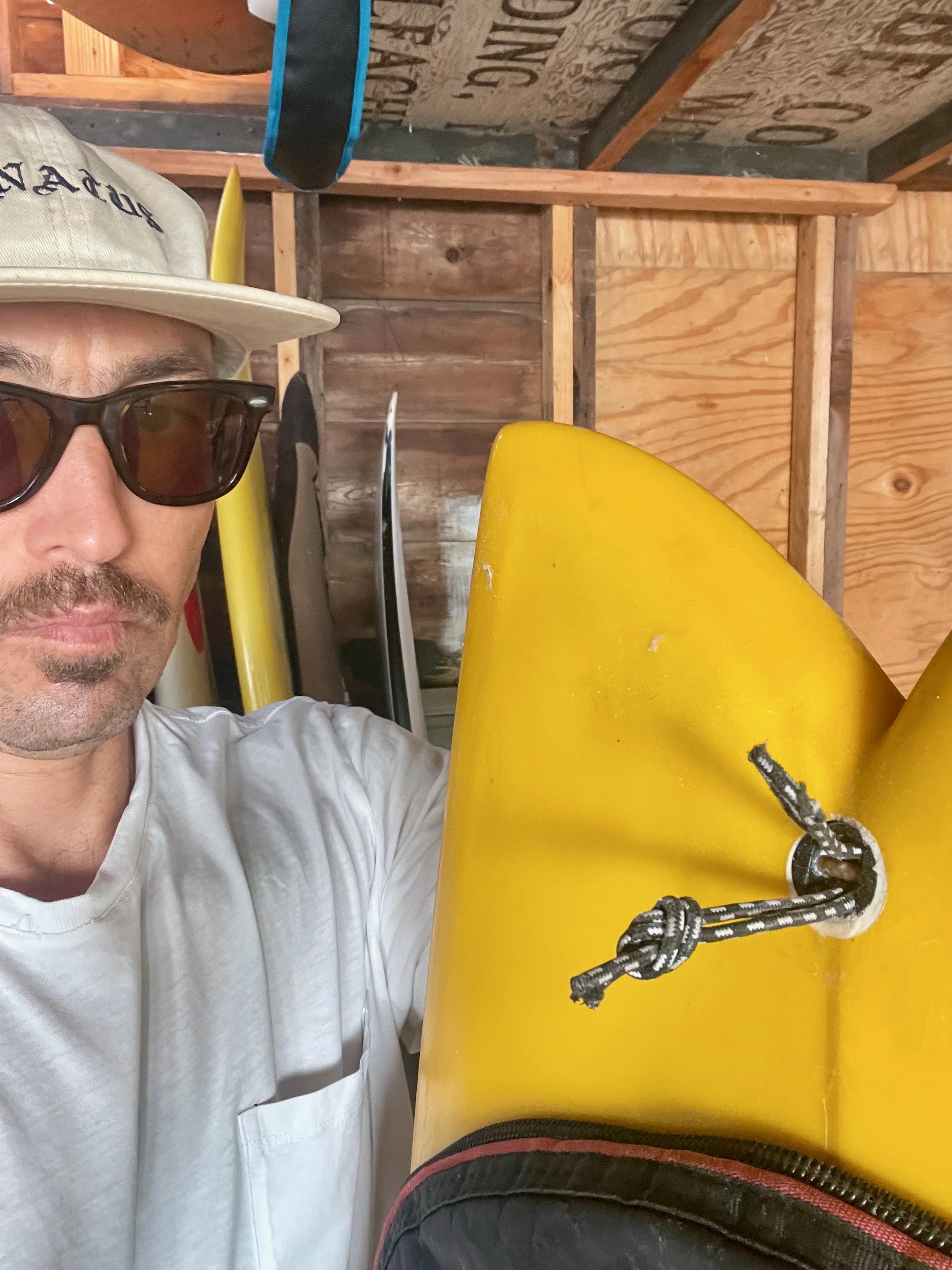
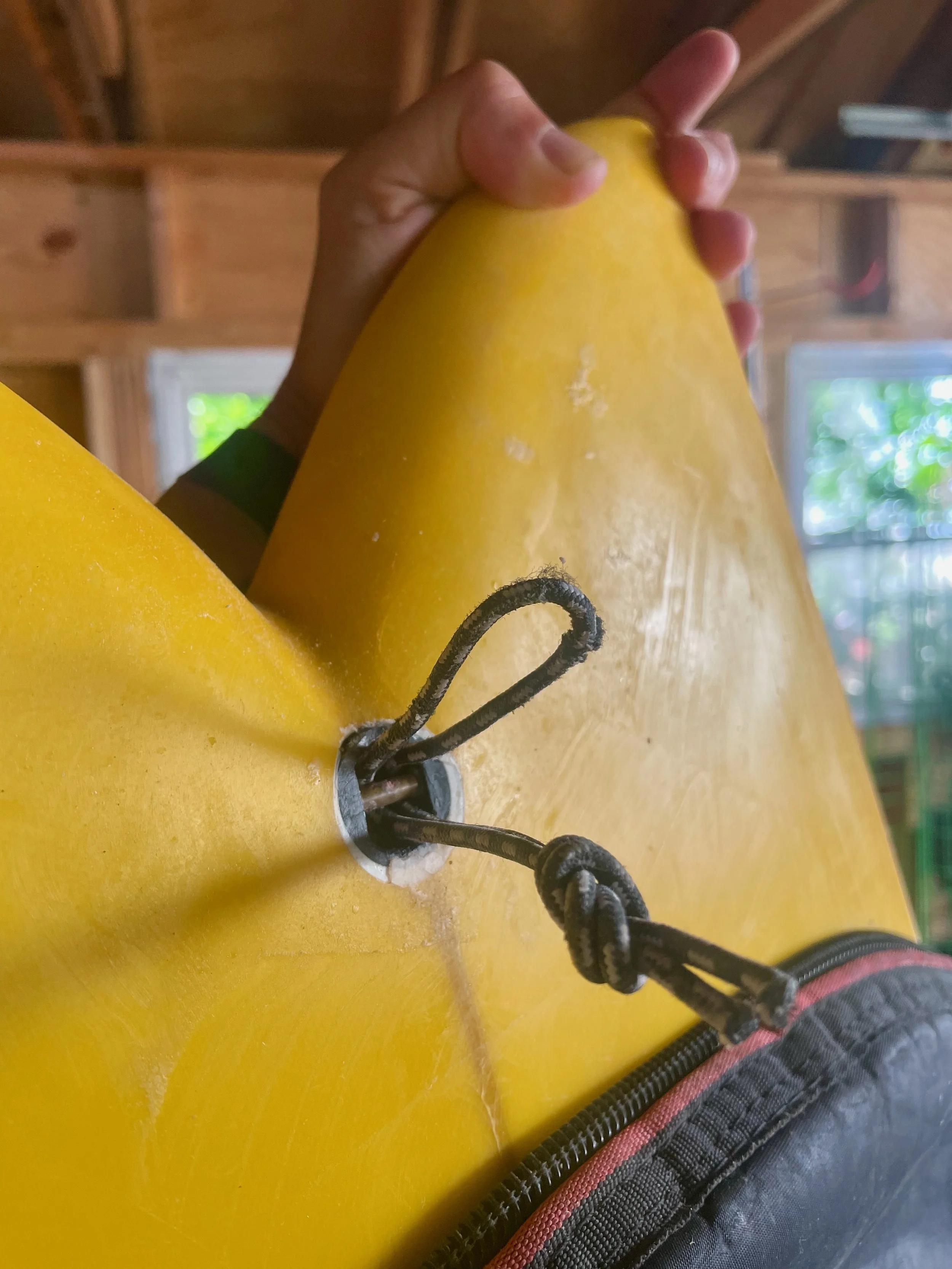
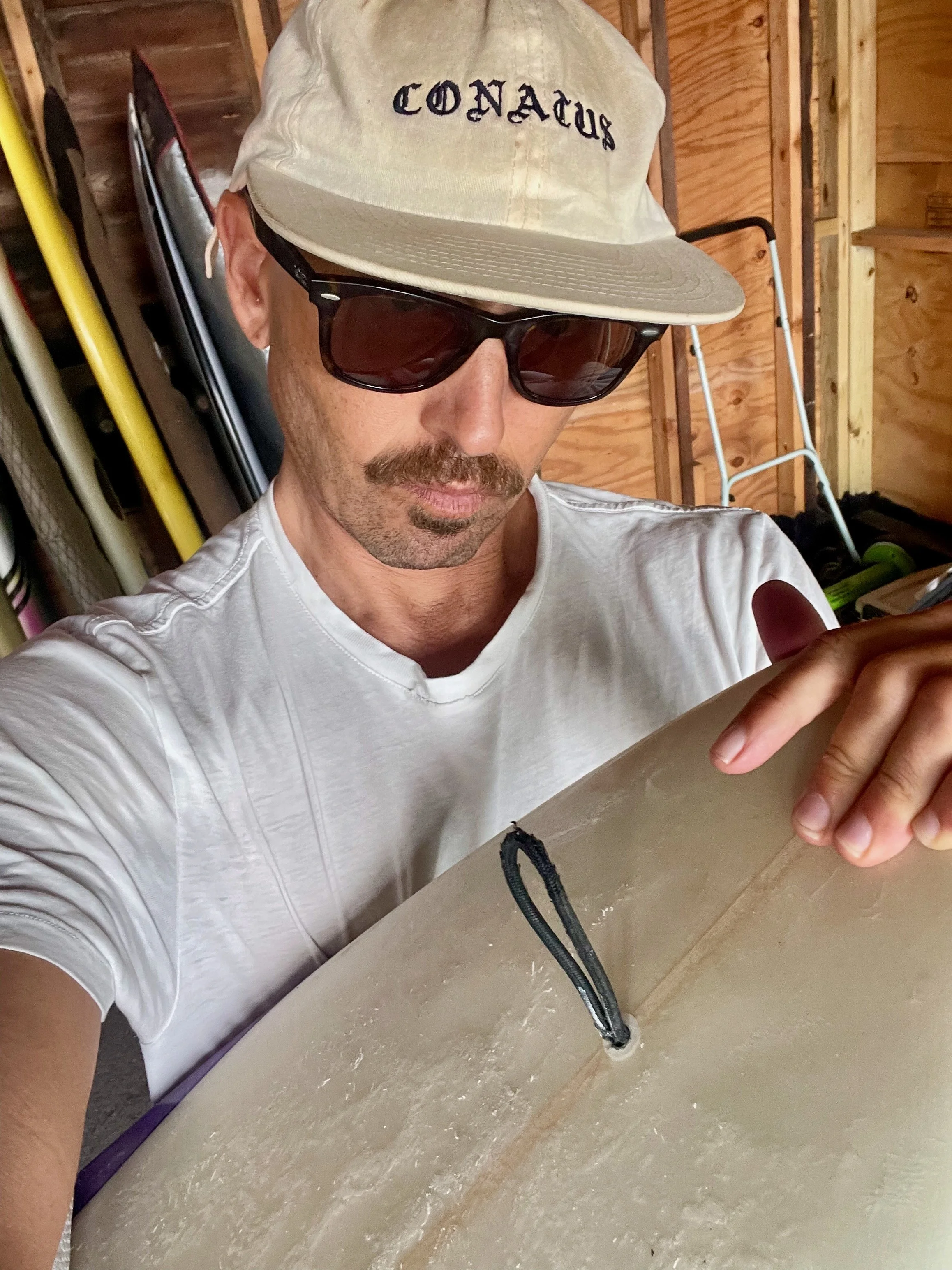
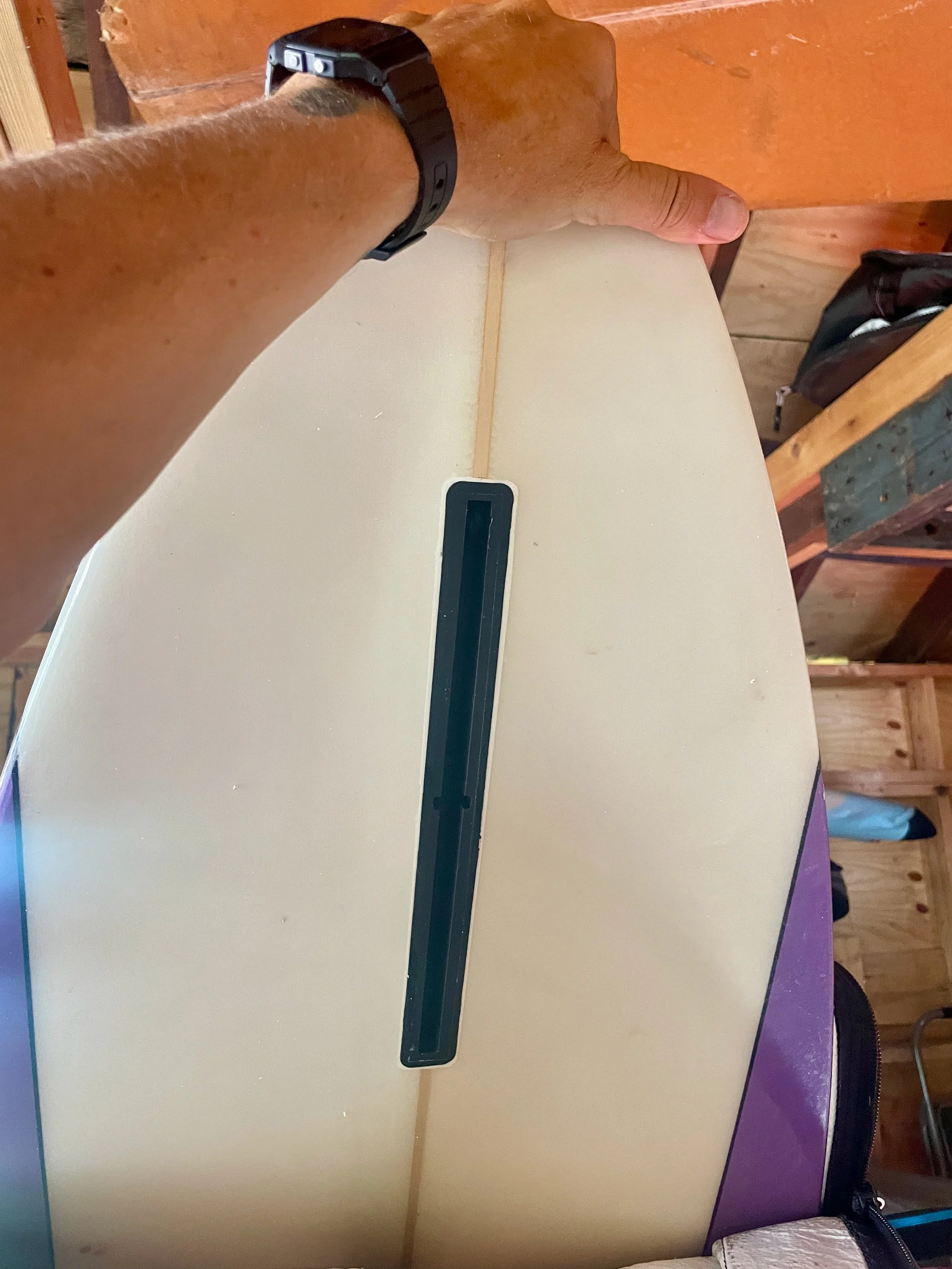
My take: we do not replace leash strings routinely as maintenance. We travel with spare strings so we can restring on the spot if one snaps — that's an emergency fix, not a habit. And if you've got a spare string and someone else's snaps, hand it over. Making someone's day like that is always a good move.
Leash Care
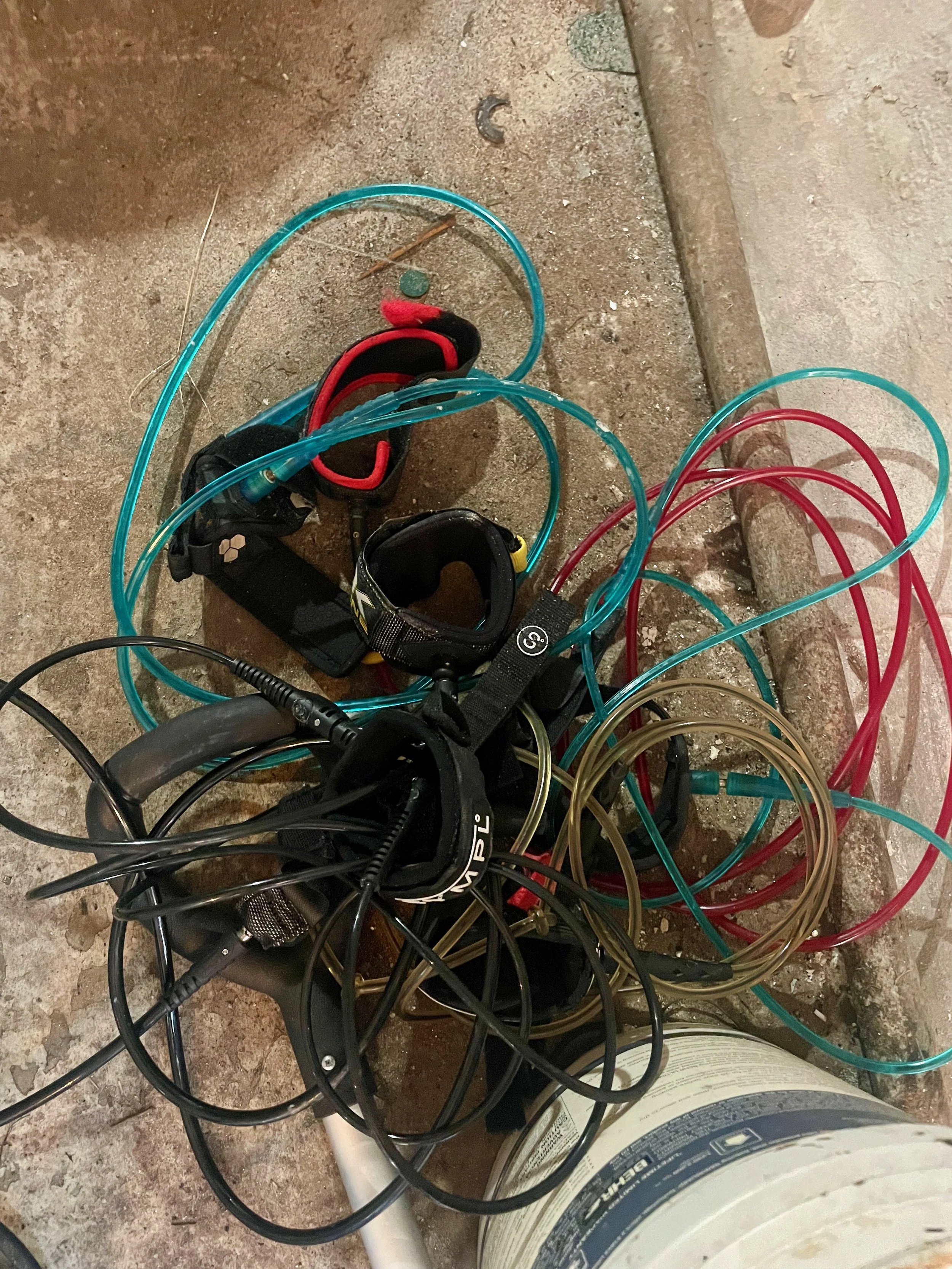
Leashes are annoying on nearly every level, and storage is one of them. If you keep multiple leashes together, they will tangle — it's the same phenomenon as computer cords. Cords find a way to wrap around each other. I don't do much to fight this. I just accept it's going to happen.
Like anything exposed to salt water, a rinse doesn't hurt. Don't leave your cord wrapped around the tail of your board for long periods between sessions — this will cause the leash to be inclined to wrap up and mess with your feet. Just take it off your board completely after every surf.
Keep leashes away from your wetsuit in storage. The velcro will find a way to stick to your suit and deteriorate the neoprene.
If you've got a leash that keeps getting stuck around your feet no matter what you do, it's probably just a dud. There are bad leashes out there. I haven't flagged one brand as producing more duds than others — it's like getting a lemon. Most leashes aren't lemons, but you can end up with one. Same goes for velcro that won't stick well, or that sticks too aggressively.
One thing to actually watch for: knots in the cord. If you paddle out and notice a knot, go in and fix it before you keep surfing. Knots will degrade the integrity of the cord and make it more liable to break.
Last note — try to buy your leashes and leash strings from a local surf shop, not from Jeff Bezos's surf shop. It's a miracle surf shops even stay in business anymore, so please support them, especially for daily gear like leashes and strings.
General Safety Recommendations
Learn to control your board. This is the recurring theme of the whole leash debate: board control is the actual skill, and the leash is not a substitute for it. Surf as though you're not wearing a leash, whether you are or not. Impeccable board control is the bar, and it's earned, not bought with equipment.
Do not drag the board by the leash — pick the damn thing up. Board control starts on the beach, before you've even paddled out. How you handle your equipment on land is part of it. Don't treat your surfboard like it's disposable, like resources are infinite — even if it's a Costco soft top. Dragging your board by the leash or rail saver, in the sand or in the water, is a bad habit that starts on shore and follows you into the lineup.
This is a pet peeve: surf schools that teach people to drag their board by the leash instead of carrying it. Fire any school that teaches this. It's not right, and it builds a bad habit. You can get seriously hurt grabbing the leash or rail saver with your hand — my client Pat had his hand ripped open grabbing the rail saver in Costa Rica. Pick up your surfboard and handle it like an adult. Even babies don't need to drag their boards — their chaperone can carry it for them. Learn to handle your board appropriately.
If the leash hog-ties you or catches on something underwater, do not panic — remove it. Every leash has a strap and a loop built for exactly this. Find it, pull it, and the cuff comes off. Some big-wave leashes come with a large pull cord specifically so you can shed the leash fast if it's putting you in more danger, not less.
That's the thing to remember about leashes overall: they're as much a liability as they are a safety mechanism. A leash that's supposed to keep you attached to your flotation can just as easily become the thing trapping you underwater. Know how to get out of it before you need to.
Summary
Where does that leave us? Whether you should wear a leash comes down to who, what, and when — your skill level, the conditions, and the context you're surfing in. There's no universal rule, and anyone who gives you one is oversimplifying. Experts in small waves, big-wave surfers at Pipe and Teahupo'o, competitive longboarders, and beginners training in empty, forgiving conditions all have legitimate reasons to go without a leash. Everyone else, most of the time, should wear one — and even then, board control is what actually keeps you and everyone else safe, leash or no leash. That's the whole point. The leash is not the safety mechanism. You are.
Get your equipment right — length matched to your board, thickness matched to your conditions, and every component properly attached, not just half-hooked and hoped for. Know how to get out of your leash underwater. And handle your board like it matters, on the beach and in the water, whether you're clipped in or not.
Insider tip: never retrieve another surfer's lost board if they're not wearing a leash
A student of mine, L., was surfing San O — a break where a lot of the pro-level longboarders go leashless. A woman near her lost her board. The shore there is rocky. L. walked on the rocks over to "save" the board for her — and in the process lost her own phone, which had been in her changing poncho.
Here's the lesson: if someone is surfing without a leash, they know the cost. That's the deal they made. Most of them, anyway. I surf without a leash often myself, and it drives me nuts when someone retrieves my board for me like they're doing me a huge favor. In my head I'm thinking, just leave it alone, go away. If someone's dead-set on "saving" my board, I'll take it and say thanks — while cursing them under my breath. And honestly, being near a loose board is its own kind of dangerous. If the leash-less surfer dings their board or takes a knock, that's a risk they've already calculated and accepted. It's the tradeoff for surfing freer.
So if you see someone lose their board and they're not wearing a leash — leave it. Let them handle it. That's the deal they signed up for.
One caveat, and it's genuinely your call: if it's obvious the board or the leash actually broke, that's a different situation than someone simply choosing to surf without one. Use your judgment. But even then, know that most surfers won't consider you a good samaritan for it — you're not going to get thanked or congratulated for "saving the day." Some will. Most won't care either way. And that's fine. You're not a bad person for just letting it be. I promise.
What to do about a genuinely dangerous non-leash surfer
There's a difference between an expert going leashless and a beginner who's falling constantly, without a leash, endangering everyone around them. If you see the second kind, it's fair to say something — but say it right. Use "I" statements. Don't accuse them of being a kook, even though they are. Something like: "I'd feel more comfortable surfing around you if you had a leash on — I've got a spare if you want to borrow it." That's it. Offer, don't lecture. If they are a dick about it, that would make sense. Even with an "I statement" you have violated their fantasy of themselves and a defensive response is natural. Nevertheless, you planted a seed in their head. They might be appropriately ashamed that they were harming others and wear a leash the next time they surf.
This isn't hypothetical. One of my clients, J, got hit in the back of the neck by a lost board — no leash, right after she'd just kicked out of a wave on the inside. The surfer who lost it clearly didn't have the ability to be out there without one. That's the whole point of earning the right to go leashless: it's not about looking the part. Posing by skipping a leash when you don't have the board control to back it up is bad form, full stop — no matter how cool you feel doing it.