

Can a person learn to surf on their own? Technically and philosophically speaking, teaching yourself to surf is not possible. You exist in a world with other people. You will be learning from others – whether that means watching my and other channels on YouTube over and over again, getting screamed at the break you’re trying to surf, observing better surfers in real time and on video, and all manner of interfacing with other human beings in the surf-o-sphere. We learn by and through others. Based on this fact alone, it is impossible. So why does the myth of the self-taught surfer exist?
The myth of the self-taught surfer is based upon a few initial assumptions or beliefs. One is that surfing is something that one should not to spend money to learn. Another is that people will like you enough to give you pointers here and there for free anyhow. Yet another is that this is how all great surfers learned. We can explode the last of these first. Great surfers grew up in surfing kinship structures (read The Four Paths Into Surfing to learn more about those).
Where did the belief that surfing is something that ought not be paid for originate? I believe this is due to the fact that the kinship structure has for centuries been the prominent way to learn to surf. It is true that in this structure no formal payment takes place in the learning hierarchy. But payment does exist. Existing within a hierarchy and obeying its norms is a form of fealty. Violating norms can lead to various sorts of violence against one’s person. One pays an emotional or egoic tax. If we only consider payment and extraction as happening by using symbolic currency – money – then we are blind to the payment structure that exists within the kinship system. All great surfers “paid to learn to surf.” That payment just looks different. And dues are owed every month. The more dues you pay up front, the fewer you pay down the line, the more respect you earn in lineups around the world. And of course when you go on surf trips, you'll still be paying guides and resorts and hosts, as custom also dictates.
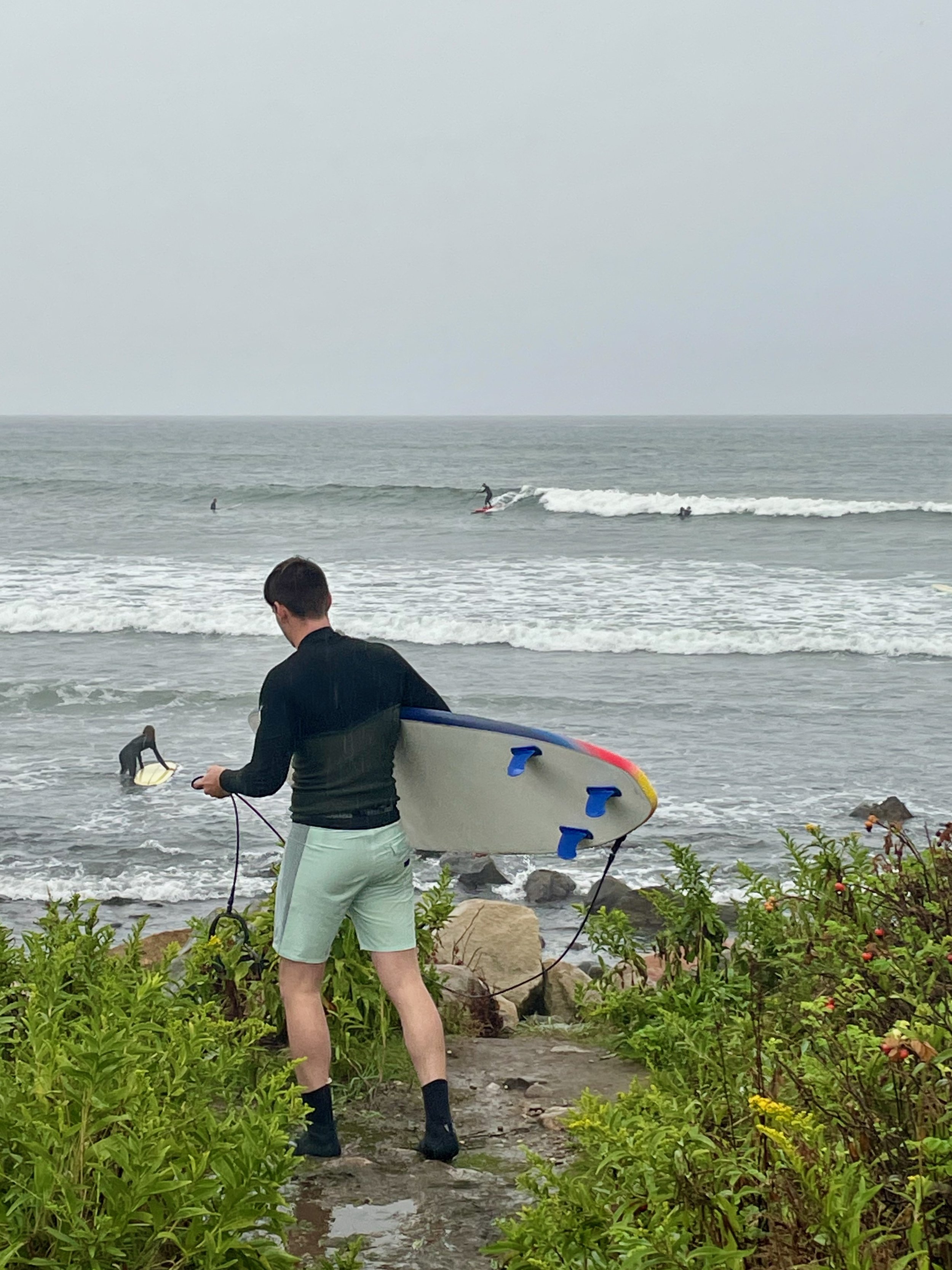
Getting consistent, solicited guidance earlier may also help you avoid some surfing fashion and equipment errors.
The “self-taught” surfer is therefore de facto also a later learner. Almost all people under twenty years of age can insert themselves more or less easily into their local beach’s kinship structure. If they want technical enhancement, they can still hire a coach, sure. No problem with more education! This said, once you’re an adult beginner and you’re trying to access surf without formal guidance, the kinship structure is all but foreclosed to you. The romance here is that you somehow manage to break into one. And that does happen. You just can’t necessarily count it. But there are things you can do to help it along: buy the locals beer, compliment people’s surfing, ask where is the best place to stay out of the way and still get waves. If someone says, “Nowhere, don’t come back here again,” well, you’ll either have to persist anyhow or find another beach. Read my article on surf bullies.
There are people who learn to surf as adults without formal instruction. The results they get vary based upon a whole number of factors. We need to establish what it even means to call their journey “successful.” Naturally, we’re going to have different ways of describing what “success” looks like in surfing. I’d say my bar for success in learning to surf is medium high. Here’s what success in learning to surf looks like:
A person becomes a surfer who can paddle out at most breaks and easily find waves regardless of crowd size. They find paddling into waves, standing up on the board, and setting a line an effortless task, especially on waves between two and six feet. They have developed a decent array of maneuvers – pumping, cutting back, floaters, head dips, kick outs to begin with – and can compress and extend their bodies in spacetime in response to the wave and the board’s dynamics. They get a few compliments here and there. People generally find them a fun and inspiring person to surf around. They are comfortable riding boards of various sizes. They can duck dive short to mid length boards, and will grab a log when the conditions call for it. There is no need for them to love or desire large waves, but some will, and that’s fine, it’s just not a requirement for success (read the related post).
That’s basically success. Every path I listed in my post The Four Paths Into Surfing can lead there. And those should be the hallmarks you look for whenever a person tells you that “they surf.” Anything less than that still counts as surfing, but I’m not so sure we’d call those sorts of practices aspirational or successful learning outcomes. The goal of surfing is not just to stand on a board on a wave, it’s to be able to enter, ride, and exit waves in a smooth and graceful manner.

Just looking chill on a board can constitute success at every level.
Learning to surf as an adult on the cheap with no formal structure is the most difficult and least reliable way to get there. It takes the longest, and causes more suffering for both the learner and the surfing community alike. If you don’t know how or where to paddle, you might find yourself in the way of others. You’re not only potentially going to get run over, you might also get yelled at and may unwittingly hurt others.
And here is where you need to be on the lookout for internet imposters. If someone is selling you the myth of the self taught surfer and using themselves as an example, you need to ask yourself whether they’ve succeeded according to the definition I laid out above. If so, then you need to be aware of survivorship bias in surfing. This person might be an exception rather than the rule. If they don’t meet the standards, well then, there you have your answer. They’re just exploiting the internet and mediocrity culture.
What Is Survivorship Bias in Surfing?
Survivorship bias in surfing means that we’re seeing good surfers who either:
a.) learned through the kinship structure and mistake this for being self taught
b.) learned to surf as an adult on the cheap and managed to develop a solid surfing practice
This distorts our understanding of whether learning to surf on the cheap as an adult actually works, making it seem more effective than it is. And only one of these fits our definition of an adult beginner surfer who learned on the cheap and succeeded. They are outliers. There is a much larger group who are out there every day nose diving, swinging their arms around like it’s going to make them turn, standing up with a two or three stage pop up, consistently missing good waves, and just can’t seem to figure the thing out. There are others who tried, developed bad habits, plateaued, and quit. We see lots of the former, and the latter are invisible.
There are still others who do not meet our standards for success who are out there, mostly online, telling their stories about how they learned to surf on their own. Anyone who loves surfing can see clearly that these people are just unpleasant to watch riding a wave. And yet they cite themselves as evidence that the path works. Those who don’t know otherwise believe them and follow their path.
Even among those who become competent, many have ingrained problems they don't know they have—bad habits that limit their progression without them ever realizing why they've plateaued.
Why Does Surf Culture Resist Instruction?
Surf culture has an anti-education streak that frames accepting guidance as weakness and self-reliance as authenticity. This attitude celebrates "figuring it out" over learning from experts, even when expert guidance produces better outcomes. The same pattern appears throughout society—resistance to expertise in favor of individual discovery—and in surfing it leads to unnecessary frustration, injuries, and years of inefficient learning.
The idea is that accepting guidance is weakness. That expertise is elitism. That doing it yourself is inherently more valuable, regardless of outcome. That real surfers earn it through suffering, not instruction.
This attitude isn't unique to surfing. We see it everywhere—the celebration of bootstrapping over learning from people who already know. We see where that leads us societally.
In surfing, it leads to a lot of frustrated people with bad habits who never reach their potential. It leads to unnecessary injuries from being in the wrong place without knowing it. It leads to years of inefficient learning that could have been compressed into months.
The defenders of the self-taught path will say: "But it's still education. Trial and error is learning."
Yes. Technically. But the outcomes are controllable in fact and practice. You can learn faster, safer, and with fewer bad habits if you accept help. The question isn't whether learning to surf on the cheap as an adult is possible — it's whether it's even responsible to self and others.
What Are the Safety Risks of “Teaching Yourself” to Surf?
Self-taught surfers face safety risks because they don't know what they don't know. Critical knowledge about rip currents, right of way, falling technique, head protection, and conditions assessment gets learned through trial and error—sometimes with serious consequences.
Here are some of the main risks:
Drowning
Hitting self with board
Hitting others with board
Broken limbs
Sprains and dislocations
Concussion
Lacerations
Smashed on rocks or reef or manmade structures like jetties
Feelings of inadequacy or lower self worth
Real persecution by other surfers
Potential violent assault by other surfers
These are also just the real risks of surfing more generally. When you go it on your own, you’re more susceptible to all of them.
How to “Teach Yourself” to Surf More Effectively
If budget is a real constraint, don’t worry. You can still learn to surf from others and achieve success by doing these things:
Study before you paddle out. “Figuring it out" doesn't have to mean going in blind. Learn to surf forecast (download my free PDF here). Read about ocean dynamics, wave formation, safety. Spend days at your local break watching waves and social dynamics. Where does everyone paddle out? Where do they sit? Who is nice? Who is mean? Watch videos of expert surfers just surfing. Prioritize videos that show them taking off and paddling into waves. Subscribe to my YouTube channel.
Prioritize paddling and wave selection over standing. The temptation is to focus on standing up as quickly as possible. Resist. Spend early sessions paddling, watching waves, trying to understand patterns. Build the foundation even if no one is forcing you.
Learn safety before you need it. Understand rip currents, right of way, how to fall. Don't learn these by having something go wrong.
Stay humble and get feedback eventually. Even if you start on the cheap, consider getting a coaching session or video analysis later. Fresh eyes can identify problems you've normalized. Remember that you’re going to pay either in time, money, pain or all three anyway.
Ingratiate yourself to the better surfers at your break. This matters. All humans love a compliment, and it’s a good way to edge yourself into a local lineup. If there’s a group of heavy locals, bring them a 12 pack of beer one day.
Is not “paying” coaches and instructors to help you Surf Worth It?
Learning to surf as an adult on the cheap is possible, but typically less efficient than learning with more formal guidance.
It really depends on what “worth it” means to you. Worth what? Years of slamming your face against the water learning bad habits that could have been nipped in the bud in your first few months of practice? Worth the money you feel you saved, but you really traded in poor decision making? Worth your sense of self as someone who never asks for or needs help?
If you have access to a local lineup with a kinship structure in place, do try to “break into it.” If you can’t, then you’re better off seeking quality instruction—whether a good surf school or a coach—you'll learn faster, safer, and with fewer habits to unlearn. That's not weakness. That's intelligence.
The choice is yours. Just make it with your eyes open. Or book a Surf Journey Assessment Call with me, and I’ll help you see how far you have come and where you are capable of going next.