
There are four paths into surfing: the kinship structure, teaching yourself, taking surf school lessons, or working with a coach. Each path is based upon different existing conditions and therefore leads to different learning outcomes. The kinship structure produces the world’s best surfers, but you have to be born into it or introduced to it at a very young age. The self-taught route is the romantic image of learning to surf, and it produces wildly variable results. Surf schools are available to all ages and are cheaper than coaching. They deliver a taste of surfing but not deep learning, and can often equip you with the wrong ideas about what it means to learn to surf. Coaching is accessible to anyone who budgets for life long education. Think of it like any advanced degree or mentorship skill. It builds correct intentions, judgments, and technique from day one. The path you choose at the beginning shapes how fast you progress, what habits you develop, and whether you stick with surfing long-term.
Beyond the kinship structure, in which by happy accident you’ve been blessed to, for example, grow up in front of Pipeline, people don't realize they have choices when it comes to learning to surf. They just do whatever seems obvious—rent a board and paddle out, or book a lesson. These aren't just different entry points. They're fundamentally different approaches to learning.
What is the Kinship Structure?
The kinship structure is how most of the world's best surfers learned—not through lessons or schools, but through proximity to a surfing tribe. It's not something you choose. Some kids whose parents surf never take to it. Others enter the water young because they live near the beach or know someone who brings them in. What matters is early immersion in a community where surfing is already happening. In that milieu, all beginners are kooks who need to find waves away from others and figure things out until they're good enough to start taking turns. The sheer awkwardness of learning automatically puts the learner at the bottom of the totem pole. And for that reason, the tribe has an incentive to make sure its younger members learn more quickly.
This isn't a formal teaching arrangement. People are just surfing. The elders enforce norms on the younger ones—where to sit, when to go, what not to do. No one is pushing anyone into waves or running through pop-up drills on the sand. The learning happens through observation, imitation, correction, and time in the water. The younger members see that they'll gain the ability to share better waves when they become more adept, so they set out to make themselves good enough to enter the real lineup. Everyone benefits when beginners progress faster. Even the roughest local doesn't want a child to get hurt at his break—and he doesn't want to busy himself with rescues when he could be getting tubed.
Almost everyone who teaches surfing actually learned this way. The irony is that what they offer in surf schools looks nothing like how they came up. Coaching is the path that most closely resembles the kinship structure—not because it replicates the tribe, but because it prioritizes the same things: ocean knowledge first, paddling second, standing as the result of everything else falling into place. It treats learning as a long-term relationship rather than a single transaction. That's what the tribe provides naturally. For those who didn't grow up in one, coaching is the closest approximation.
What Is the Self-Taught Path to Surfing?
Do not mistake the self-taught path from the kinship structure path. It’s a common error. Kelly Slater is not self taught. Carissa Moore is not self taught. I am not self taught. No virtuous surfer ever was self-taught. Every great surfer has mentors.
But the romantic image of the self-taught surfer is real, and many people do believe that you just grab a board and go surfing. You’ll figure out how to learn to surf through trial and error, with no formal instruction. It's the most romanticized approach in surf culture—celebrated as the "authentic" way to learn—but produces the most variable outcomes. Some self-taught surfers figure it out; many develop bad habits they don't know they have and plateau far below their potential.
The story surf culture tells: real surfers didn't take lessons. They grabbed a board, paddled out, got worked, and figured it out through persistence. Nobody held their hand. They earned it. This is the idea of bootstrapping – that you just put on your boots and figure it out. Numerous educational theories have disproved this as an effective method for doing most anything well or virtuously. To hold the belief that self reliance is our highest goal, you make an arch category error: you assume that self reliance is the highest value, the most laudable goal and aim of a human life. That is a claim that requires in one of its premises a justification of what other people mean to us and how they affect our systems of value. It’s an extraordinarily cynical stance. It avows the presence of others, but questions anyone who would rely on them for his own continued well being. The fact of the matter is that one cannot avoid relying on others. To do so is a fool’s errand. To accept that we’re all here to toil with and for others is to see more clearly.
Looked at in this way, there really is no such thing as a self-taught surfer. If you rent a board or buy one based on something like my beginners guide to your first surfboard and just go surfing, you’re going to learn from other people. What and how you learn it will not be controlled.
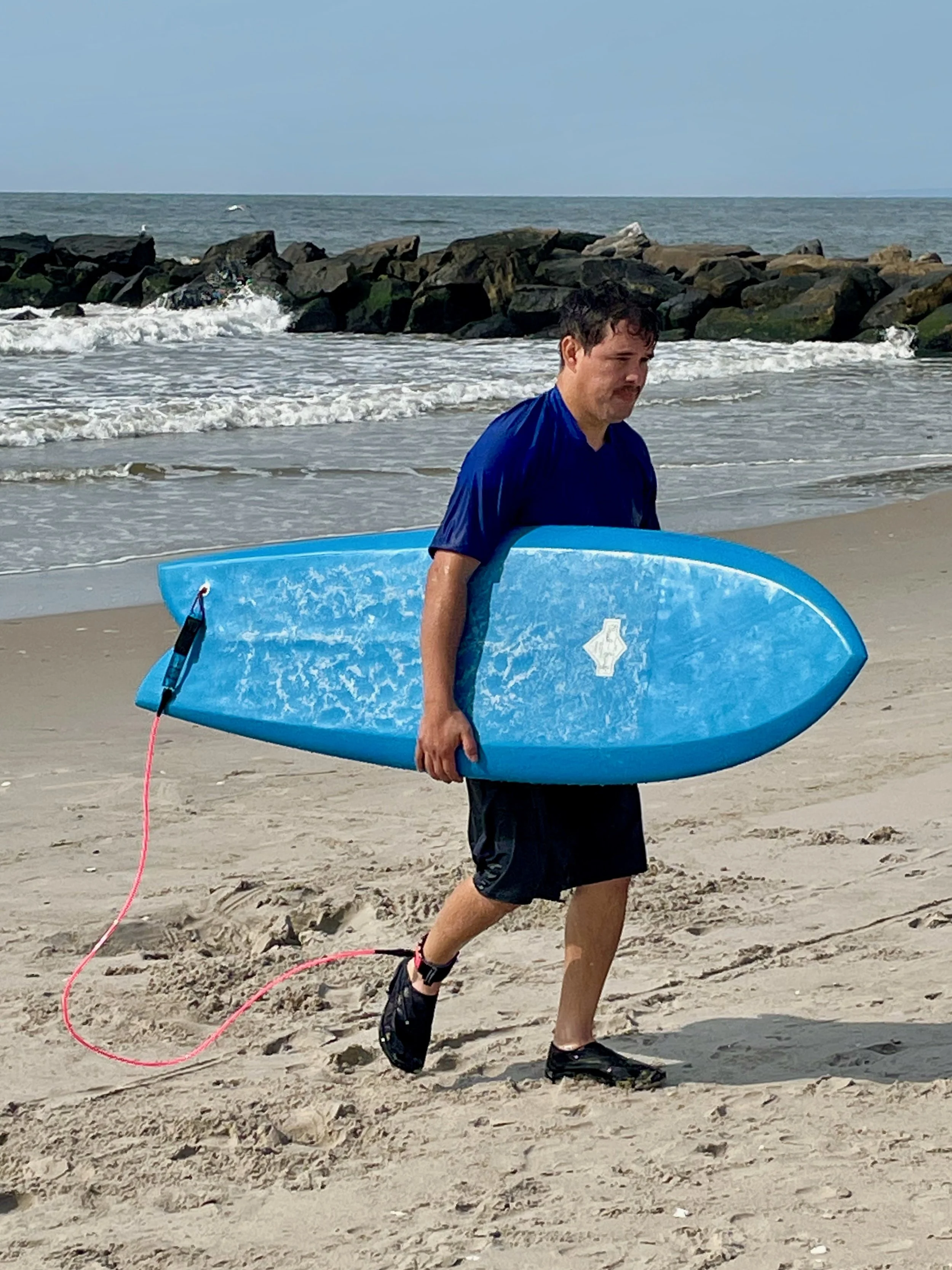
The problem the “self-taught surfer” is really trying to solve is how to learn something hard that others already know much more about and spend as little money on educating himself as possible. This approach is at once miserly and hubristic. Hubris is pride mixed with a willed ignorance. Everyone learns more effectively when they avow the reality of their vulnerability and asks for help.
A word of warning: when learning to surf there is no escaping payment of one form or another. Everyone pays to play. EVERYONE. Yes, it’s true that people pay different amounts of different sorts of currency. And the education delivered looks different in each case. But in the end you will pay with some sort of grift – a piece of your life, time, energy, emotions, and resources.
What Do Surf Schools Actually Teach?
Surf schools teach beginners to stand on a surfboard, typically in a single session. The standard model involves beach pop-up drills, then an instructor pushing you into whitewaters while you attempt to stand. This approach is optimized for short-term satisfaction—standing once and going home happy—rather than long-term skill development. Many schools also teach technique shortcuts that create habits surfers spend years unlearning.
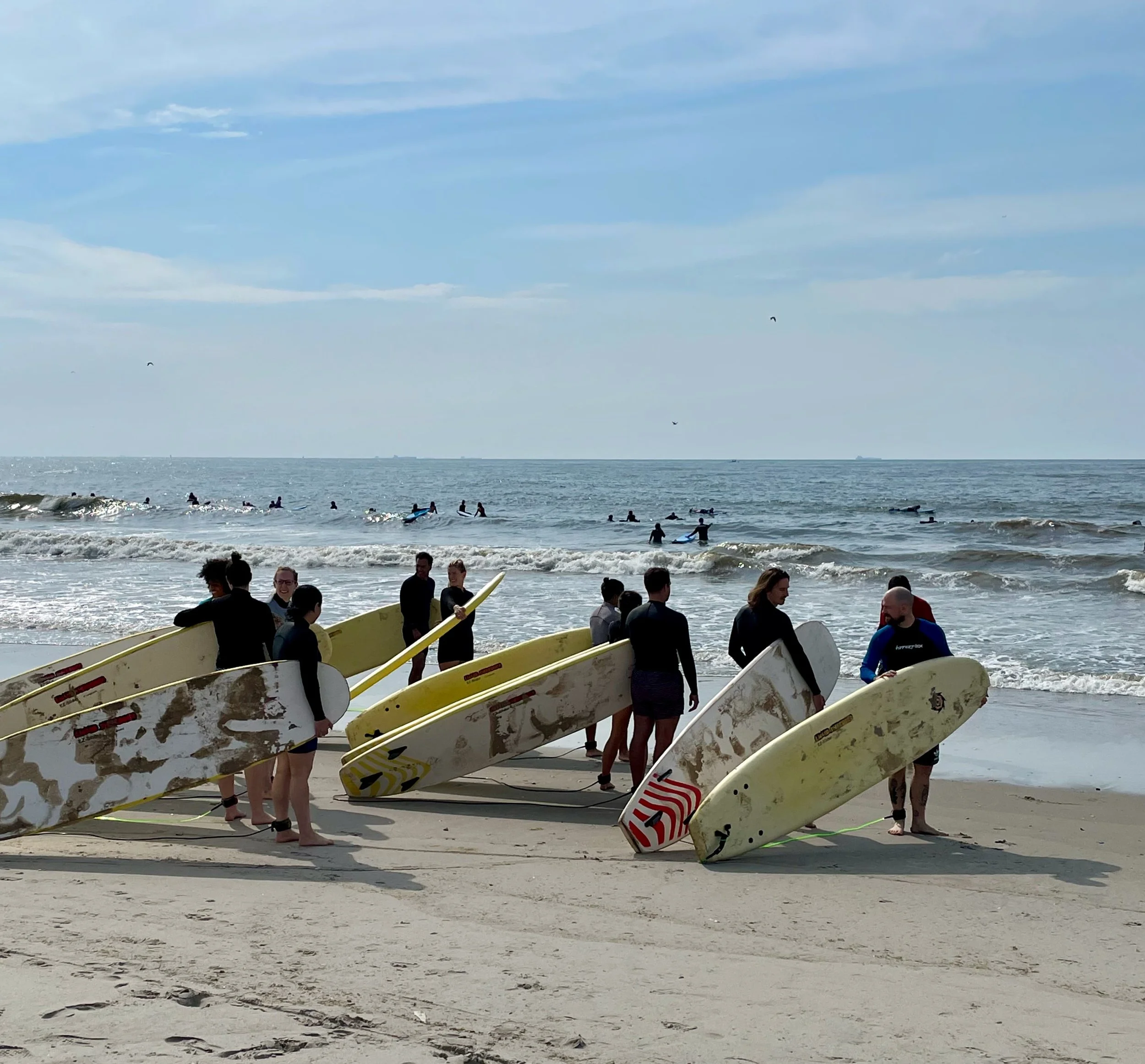
Surf schools aren't bad. They're great for kids—I've seen excellent programs in France that provide community and structure for children of non-surfing parents. Some adults thrive in group settings too.
But the business model is clear: stand once, go home happy, leave a five-star review. That's what the experience is optimized for.
The shortcuts are the bigger problem. Two-stage pop-ups, back-foot-forward methods, cobra push-up positions—these techniques get beginners standing faster but create habits that must be unlearned to progress. No expert surfer stands up this way.
What Does a Surf Coach Do Differently?
A surf coach teaches the foundational skills that actually make someone a surfer: paddling technique, wave judgment, timing, positioning, and ocean knowledge. Unlike surf schools, coaches prioritize these fundamentals over standing up quickly. You can start with a coach from day one—no prior lessons needed—and build correct habits from the beginning rather than developing shortcuts you'll later unlearn.
The difference is the approach. A coach understands that surfing isn't fundamentally about standing on a board. Standing is the icing. The cake is everything that happens before and during the stand.
With a coach, you learn to paddle before you pop up. You learn to read waves before you catch them. When you finally stand, it's because you've created the conditions for it—not because someone pushed you.
This takes longer at first. You may not stand on day one, or you may. But when you do stand, you'll know why it worked. And you won't have to unlearn a catalog of bad habits to reach the next level.
The money-saving way to learn is to not develop bad habits in the first place.
Which Path Produces the Best Results?
The kinship structure and coaching produce the most reliable results for surfers who want long-term progression. “Self-teaching” produces wildly variable outcomes with high risk of ingrained bad habits. Surf schools provide a taste of surfing suitable for one-time experiences but aren't optimized for skill development. The key insight: learning outcomes are controllable based on which path you choose.
Here's what each path produces:
Kinship structure: you were born lucky. Congratulations.
Self-taught: Wildly variable. Some figure it out; many don't. Even the competent often have blind spots. Brutally inefficient learning curve.
Surf school: A taste. Good for kids, tourists, one-time experiences. Not optimized for progression. Often teaches shortcuts that create bad habits.
Coaching: Slower initial gratification, faster long-term progression. Builds correct habits from the start. More reliable outcomes.
How to Choose the Right Path
Choose based on your goal: if you want a one-time experience, any path works. If you want surfing to become part of your life, coaching or strategic self-teaching with video feedback produces better outcomes than the standard surf school model. Be honest about what you want before booking anything.
If you just want a taste—to try surfing once and see what the fuss is about—any path works. Have fun.
But if you want surfing to become part of your life, the path you take at the beginning shapes everything that follows.
Over the next few posts, I'll go deeper on each path: why the self-taught myth is misleading, why surf instructors default to push-to-stand, and what a coach actually does differently. Then we'll get into the logistics of planning a surf trip that sets you up for real progression.
Start by being honest about what you want. The choice follows from there.