

Every week, I watch talented people struggle in the lineup—not because they lack ability, but because they’ve been fed a steady diet of surfing misinformation. After coaching hundreds of students from complete beginners to advanced intermediates, I’ve identified the core myths that create more problems than they solve. Most surf education focuses on getting people standing quickly using shortcuts that actually slow long-term progression. The real issue? A fundamental misunderstanding of what surfing actually is. Let’s bust the myths that keep you spinning your wheels and reveal what creates genuine progression in the water.
Myth #1: Surfing is about standing up on a surfboard

Learning why these waves break where they break and how to navigate the lineup is more impotant than standing.
What people believe: Most beginners think surfing means getting to your feet on a moving wave as quickly as possible. Surf schools reinforce this by celebrating every successful "pop-up" as progress.
Why this hurts your progression: This foundational category error creates all other learning problems. When you focus solely on standing up, you miss the actual fundamentals that make surfing possible: wave reading, ocean knowledge, positioning, and board control.
The reality: Surfing is primarily about understanding how waves work and where to position yourself to harness their energy. Standing up is just one way to ride that energy—and it emerges naturally once you master the real skills. Professional surfers spend most of their time analyzing conditions, not practicing pop-ups.
What to focus on instead: Learn basic wave forecasting and how to read conditions before worrying about your stance. Understanding why waves break where they break matters more than getting to your feet quickly.
Myth #2: You should move your back foot forward first when popping up
What people believe: Many surf instructors teach a "step-up" technique where you bring your back foot forward first, then adjust your front foot (see video above). This seems logical and feels safer for nervous beginners.
Why this hurts your progression: Zero professional surfers pop up this way. This hack technique only works in slow, mushy waves and creates bad movement patterns that fail completely when you encounter faster, more powerful surf.
The reality: There are many different ways to pop up, but none of them require initiating with the back foot forward. The key is first practicing basic glide-up pop-ups on land until you have them down. Breathe into them and release anxiety from your body. Keep your head and your eyes up. In the water, the focus should be on wave judgment and timing. The better you get at picking waves that will let you enter smoothly, the easier it will be to perform your desired graceful pop-up at whatever speed you need. You can take your time in slower waves, but you need to be quick when it's pitching! Knowing the difference is the first step.
What to focus on instead: Master basic pop-up mechanics on land first, then focus on wave selection and timing in the water. Check out this drill for improving your pop-ups:
MYTH #3: SMALLER BOARDS ARE EASIER TO LEARN ON
What people believe: Shorter boards look less intimidating and seem easier to handle. Many beginners assume they should start with 6-7 foot boards because "real surfers" use short boards. People are also in a rush to graduate to shorter boards for practical reasons—they fit in small apartments and cars, they're lighter to carry, and they seem easier to turn because they're so sensitive.
Why this hurts your progression: Undersized boards reduce flotation and paddle power precisely when you need them most. People also believe shorter boards are easier to turn, but truly virtuous shortboard surfing is reserved for people who learned as children or young adults—and even those surfers learned on equipment that floated them substantially before they "foamed down." You want to complete a whole checklist of surfing goals before you even think about purchasing a shortboard. This myth ruins more surfing styles prematurely than almost any other.
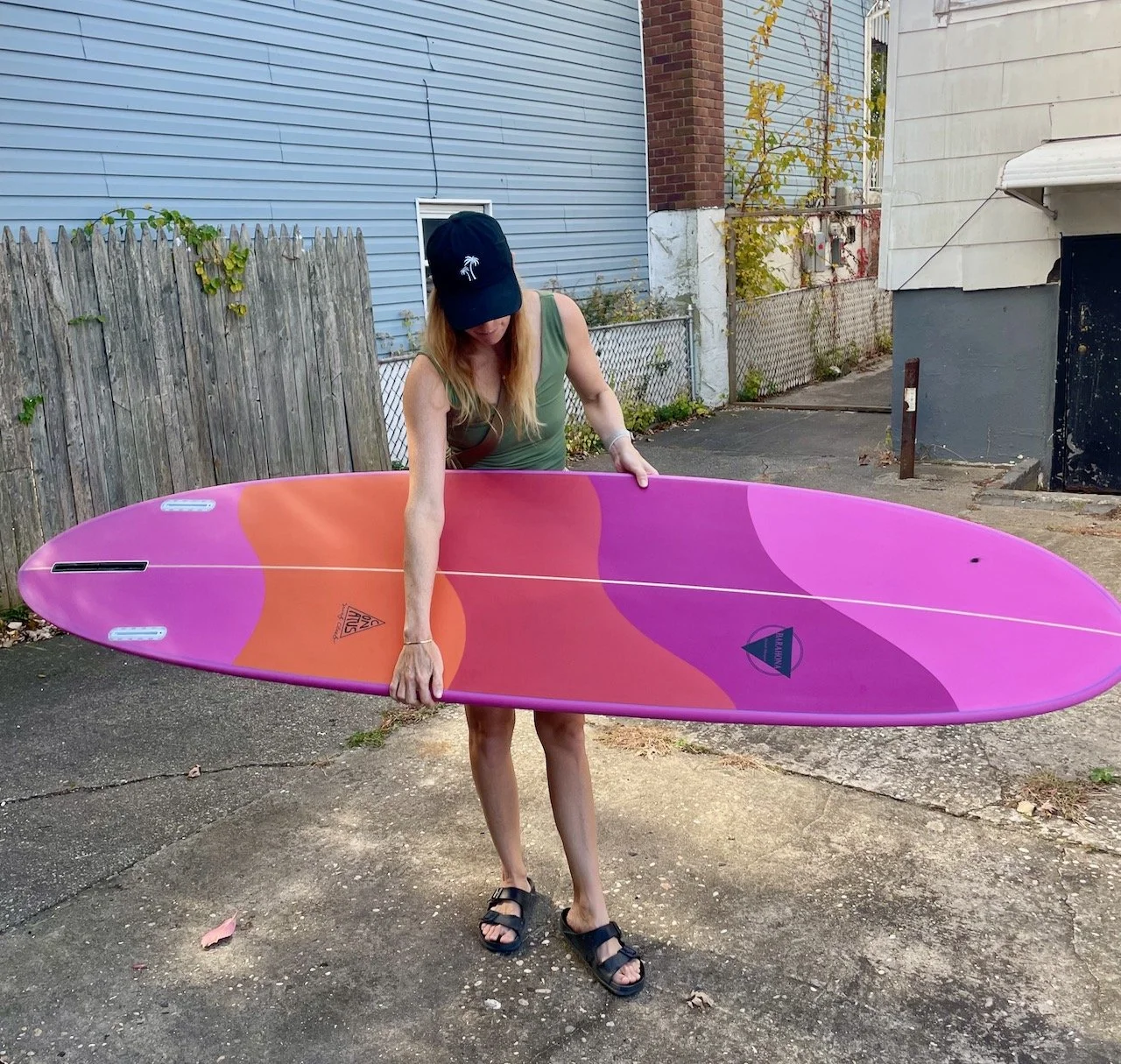
The reality: Proper learning boards are 8-10 feet long with lots of volume and width. These dimensions provide the stability and paddle power that let beginners focus on wave reading and positioning rather than just surviving. Shortboard mastery requires years of foundational skills that can only be built on longer, more stable equipment.
What to focus on instead: Choose boards based on your actual skill level, not convenience factors. Master the fundamentals on proper beginner equipment before even considering shorter boards. Volume and length accelerate learning—you can always size down after building solid foundations.
MYTH #4: YOU PUT YOUR HEAD DOWN AND PADDLE HARD FOR EVERY WAVE
What people believe: When you see a wave coming, put your head down and paddle as hard as possible to catch it. Maximum effort equals maximum success.
Why this hurts your progression: This approach only works for experienced surfers who already know what the wave is going to do. They're timing this intense paddling phase where their focus is just on generating speed. If you're not at this advanced stage yet (and let's be real, you're not), then you need to keep your head up and look at the wave so you can time your entry properly.
The reality: Better positioning means you paddle less and have more time for a graceful pop-up. The bulk of your paddling shouldn't be going for the wave, but getting and maintaining proper position in the lineup.
What to focus on instead: Work on positioning first, then timing. Keep your head up to read the wave during your approach. Learn where to sit in the lineup so waves come to you, rather than frantically chasing every set.
Myth #5: Beginners need to be pushed into waves
What people believe: Getting pushed by an instructor or friend is necessary for beginners who can't generate enough paddle power to catch waves on their own.
Why this hurts your progression: Being pushed prevents you from learning proper wave timing and paddle technique. You become dependent on assistance instead of developing the skills needed for independent surfing.
The reality: If you're physically capable of paddling and have a properly sized board, you can catch waves independently from day one (see Dave in video). The push is a convenience, not a necessity.
What to focus on instead: Learn proper paddle technique and wave timing. Start in smaller, gentler waves where you can practice these skills without assistance.
Myth #6: You should initiate turns by swinging your arms and upper body
What people believe: Big arm movements and upper body rotation create powerful turns, just like in skiing or snowboarding. Swing your arms to generate momentum and throw your body into the turn.
Why this hurts your progression: Wild arm swinging creates uncontrolled movements that throw you off balance. If you're just swinging without direction, your board won't go anywhere productive. You need directed motion, not counter-rotation that fights itself.
The reality: While your lower body does follow your upper body (especially your eyes), effective turns require purposeful, directed movement. Your eyes lead by looking where you want to go, but your arms provide balance and fine-tuning, not the primary turning force.
What to focus on instead: Practice looking where you want to turn while keeping your arms centered and controlled. Let your eyes guide the movement, use your back foot to initiate the turn, and keep your upper body balanced rather than wildly swinging.
Myth #7: surfing is easy
What people believe: Social media makes surfing look effortless and natural. Instagram posts and YouTube videos show people gliding gracefully across waves, making it seem like anyone can pick it up quickly. The aspirational content suggests that if you're not "getting it" right away, something's wrong with you.
Why this hurts your progression: When you struggle with what looks so easy online, you start thinking you're a weirdo who "doesn't get it." This creates frustration and self-doubt that interferes with learning. You begin questioning your ability instead of recognizing that you're attempting something genuinely difficult.
The reality: Surfing can be easy—in perfect conditions, on the right equipment, with ideal waves. But most of the time, it's actually harder than all that graceful aspirational content makes you think. It's difficult, demanding, intellectual, and physical. You have to put so many variables together at once: reading waves, timing, positioning, board control, ocean knowledge, and physical technique. Some sessions are easier than others, but from fitting it into your busy life to affording decent equipment to actually getting the waves you want—it's not easy!
What to focus on instead: Embrace the difficulty as part of what makes surfing rewarding. Stop comparing your learning process to highlight reels. Recognize that every expert surfer struggled through the same challenging fundamentals you're working on now. The complexity is what makes mastery so satisfying.
Myth #8: Beginners don’t deserve a “real board”
What people believe: You should start with cheap foam boards from big box stores and "earn" better equipment as you improve.
Why this hurts your progression: Poor quality boards make learning unnecessarily difficult. Bad equipment creates bad experiences and slows skill development.
The reality: Quality equipment that fits your current skill level accelerates learning significantly. You deserve gear that helps rather than hinders your progression.
What to focus on instead: Invest in a properly designed beginner board from a reputable shaper or brand, even if it costs more initially. Good equipment pays for itself in faster progression. Check out my Complete Guide to Your First Board.
Myth #9: Beginner equals kook
What people believe: Being new to surfing automatically makes you a "kook"—someone who doesn't belong in the lineup and should expect disrespect.
Why this hurts your progression: This attitude creates anxiety and prevents beginners from learning proper lineup etiquette and communication skills.
The reality: "Beginner" describes skill level; "kook" describes behavior. You can be a respectful, aware beginner who contributes positively to any lineup.
What to focus on instead: Learn surf etiquette, practice honest self-assessment of your abilities, and communicate appropriately with other surfers. Respect earns respect.
Myth #10: You need marathon sessions every surf
What people believe: More time in the water always equals faster improvement. You should surf until exhaustion to maximize each session.
Why this hurts your progression: Fatigue impedes learning and increases injury risk. Quality practice beats quantity every time.
The reality: Shorter, focused sessions often yield better results than marathon slogs. Your brain and body need recovery time to integrate new skills.
What to focus on instead: Plan sessions around specific goals and energy levels. Sometimes a focused 45-minute session teaches more than three hours of unfocused thrashing.
Conclusion
These myths persist because they promise quick results, but surfing isn’t a quick-result activity. It’s a lifelong practice of reading water, understanding energy, and moving in harmony with forces far greater than ourselves. The good news? When you focus on the real fundamentals—wave reading, positioning, board control, and ocean knowledge—progress accelerates naturally. Standing up becomes inevitable rather than the primary struggle. Start with Myth #1. Ask yourself: am I trying to learn surfing, or am I just trying to stand on a board? Your answer will determine everything that follows.