

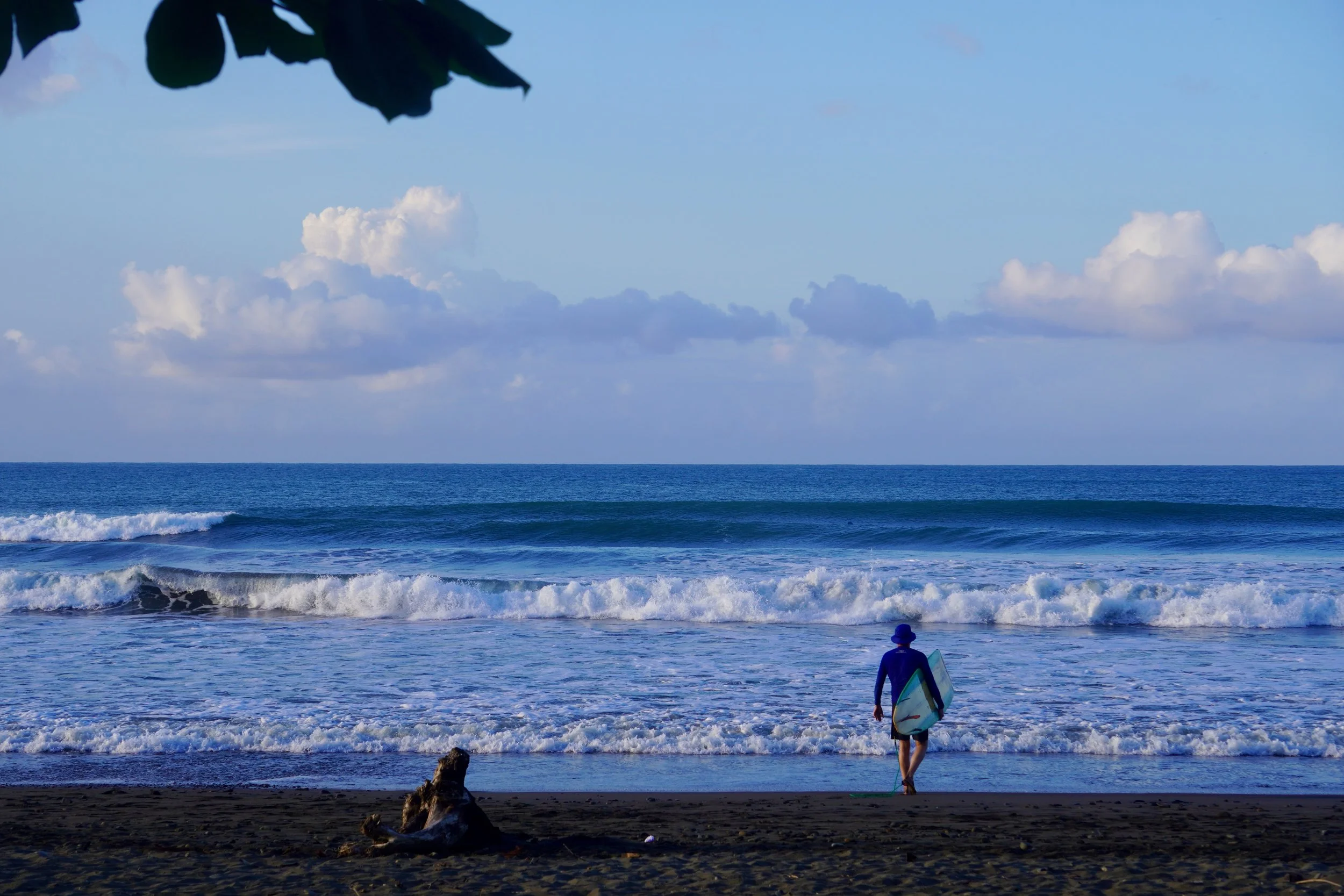
To me it is obvious why surfing Costa Rica is so popular. The water is warm, the waves are plentiful and varied, the people are lovely, the landscapes are beautiful, and you will never eat better tropical fruit anywhere else in the world. I love surfing Costa Rica because there are waves there almost 365 days a year. It's one of the most consistently surfable destinations on planet earth.
Costa Rica has 1,290 total kilometers of coastline — 212 km on the Caribbean coast and 1,016 on the Pacific. I've surfed a good deal of it, but to lay my cards on the table, I'm not an expert on the Caribbean or the northwest coasts. While I have great general knowledge of surfing Costa Rica, my specialty is in surfing the southwest, where I've owned a property — Rancho Diandrew — along with my dad, Richard, and brother, Andrew, since 1989. What follows can be used as a general guide to surfing Costa Rica, but it has a special emphasis on the southwest, since that is where I've primarily accumulated my experience.
Personal Surfing Costa Rica History
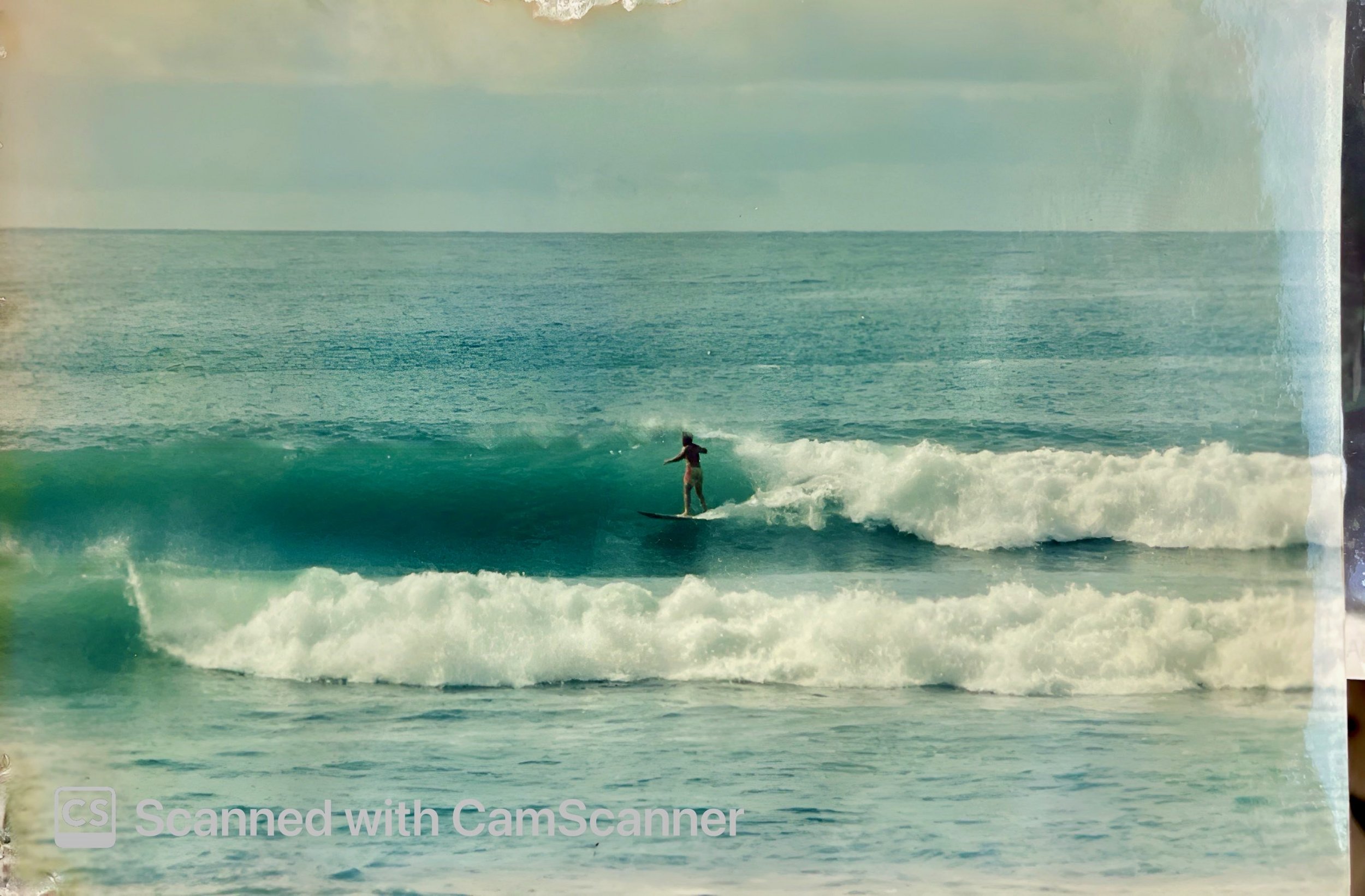
My dad, Richard ‘Maddog’ Mattison, surfing Backwash Bay in Matapalo ca 1991. Photo by 11 year old Dion with my dad’s Nikon camera.
My dad was on the hot take before a lot of other surfers. In 1989 he bought land in the south west, up a mountainside overlooking the sea and the "Whale's Tail" (Bahia Ballena), between the little villages of Dominical and Uvita. My brother, Andrew, and I took our first international surf trip there in 1991. I was just turning 11 on the trip, and Andrew was 9. My dad had been visiting since 1987 and had already established contacts like Juan Lopez who owned the Roca Verde restaurant and cabinas on the south end of Playa Dominical. In fact dad bought our property from Juan's uncle.
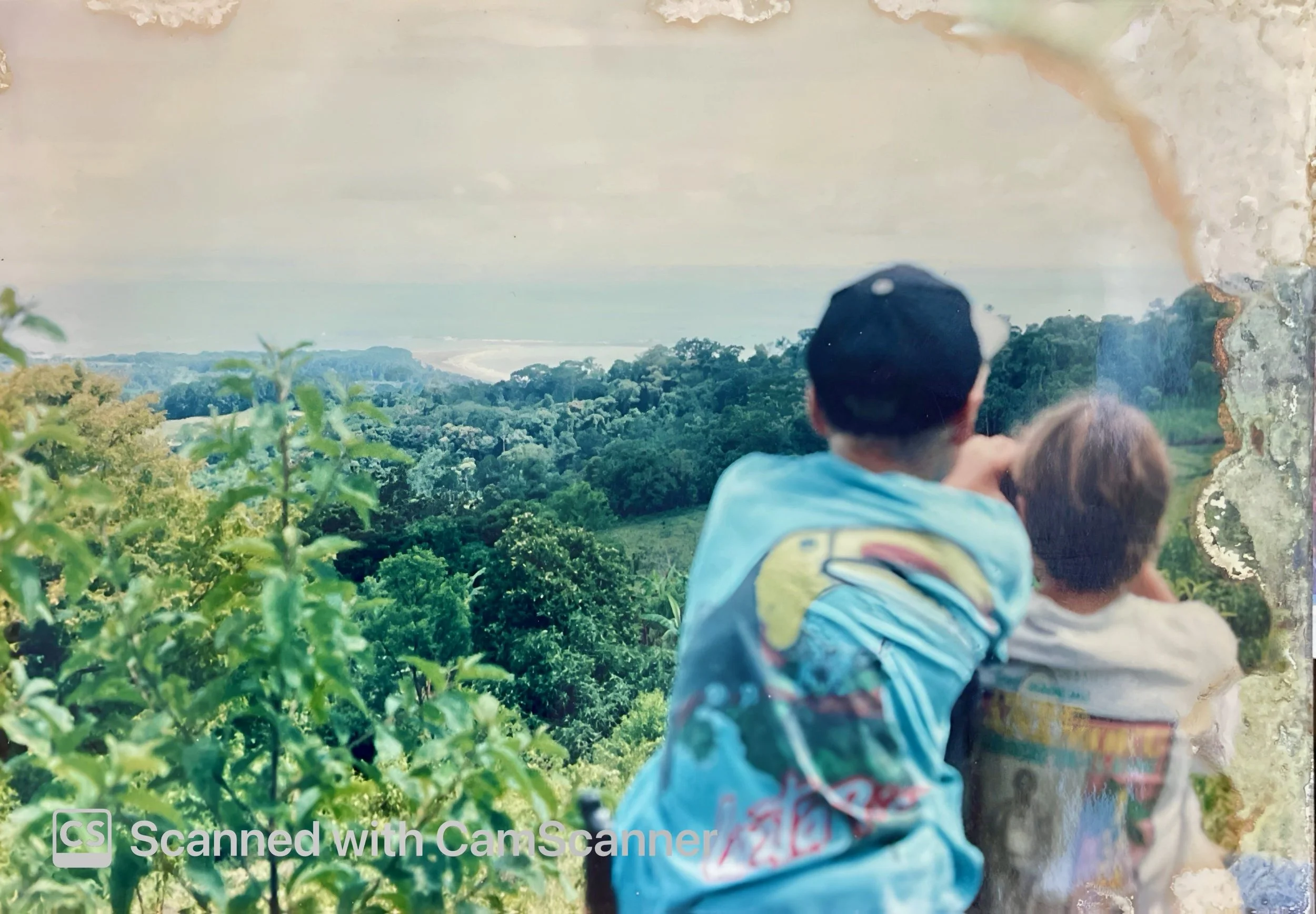
Andrew and me at Rancho Diandrew in the early days.
We took another trip together in 1992. On our first two surf trips to Costa Rica Andrew and I were too small to really enjoy the large south swells. My dad, however, was pumped. We watched him surf double overhead waves alone at Playa Dominical, Punta Dominical, Playa Hermosa (in the north, where we'd always stop for a few nights on our way down), and the barreling right handers just to our south on Cabo Matapalo (about a two and a half hour drive from our property). If I asked nicely enough he'd take us to the sheltered breaks of Playa Dominicalito, where today surf schools operate for the same reason. But mostly we surfed the reforms inside of whatever giant tubes he was focused on.
By 1997 I was itching to get out of high school as soon as I possibly could. In the beginning of my senior year I applied to become an exchange student with AFS (American Field Service) and was accepted. I requested to be placed near the coast. They first put me in the village of Robles, about a 90 minute drive from San Jose. I had the good fortune of landing near the second best left hander in the country: Boca Barranca. I got to surf Barranca after school and on weekends. I would also surf this bonkers right wedge at the cruise ship terminal in Caldera called "El Ollo."
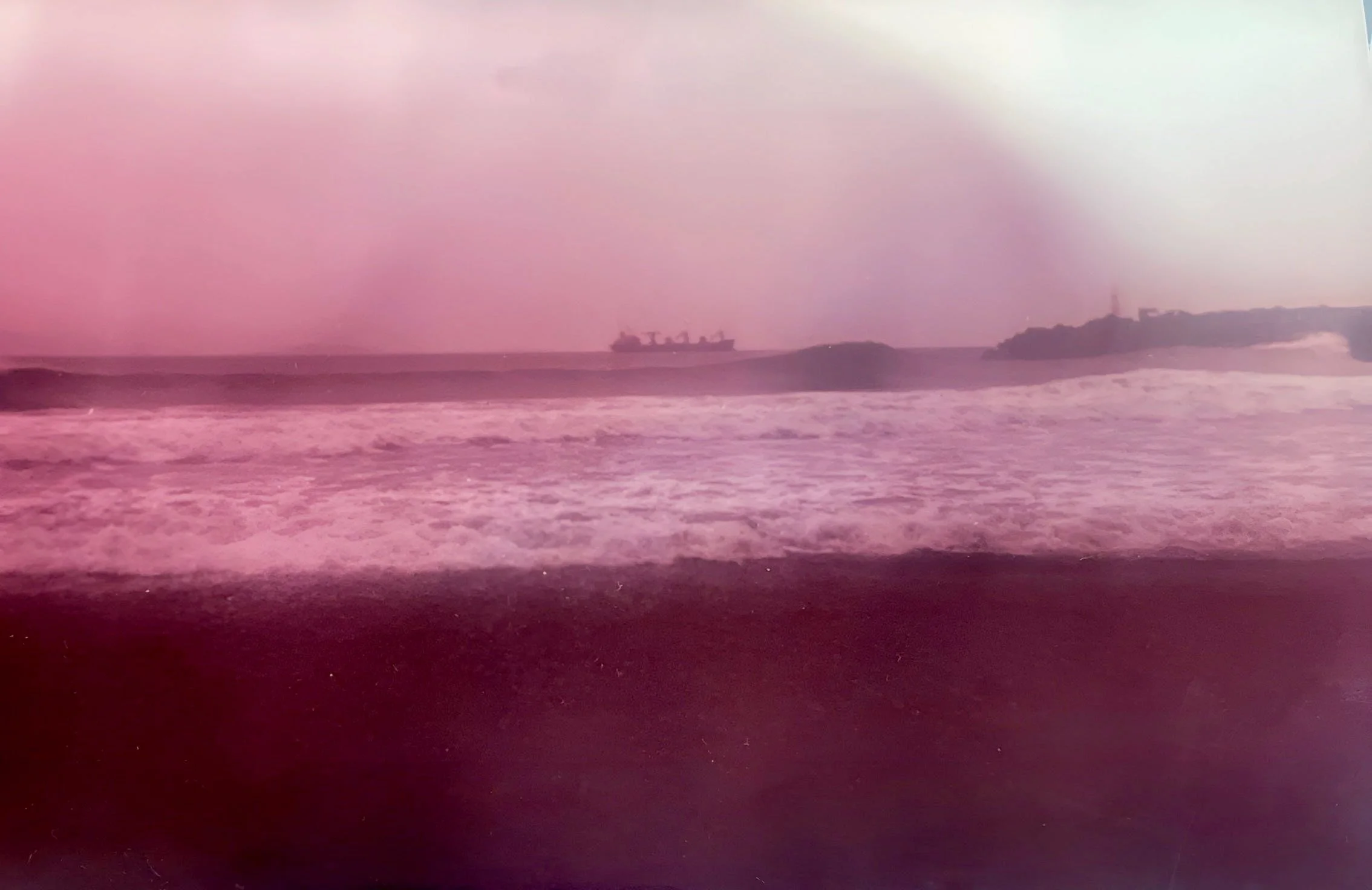
El Ollo in Puerto Caldera — photo by me with a point and shoot ca 1998.
It was dirty. I had some backpacks stolen there (you're an idiot if you just leave valuables unattended on the beach — and I was a 17 year old idiot), but the triangular peaks were worth it. Somewhere midway through the program I was transferred to another family because my hosts thought that I "surfed too much." I moved deeper into Puntarenas, towards the actual city center and port, closer to the ferry that connects mainland Costa Rica to the Nicoya Peninsula and waves like Malpais and Playa Santa Theresa. I took the ferry over a few times, and even found my way further north, surfing spots like Tamarindo river mouth, Playa Grande, Witches Rock, Ollies Point, Playa Negra, and Avellanas. When the mid year school break hit in July I hitched a ride to catch a south swell in Pavones and was permanently ejected from the exchange program (for hitchhiking and ditching school). After my ejection I stayed on through the wet season. I returned to America in November 1998. While in Costa Rica I had become fluent in Spanish, accidentally vegan (when you're living on your own as a 17 year old you can't afford much more than rice and vegetables), and much, much better at surfing.
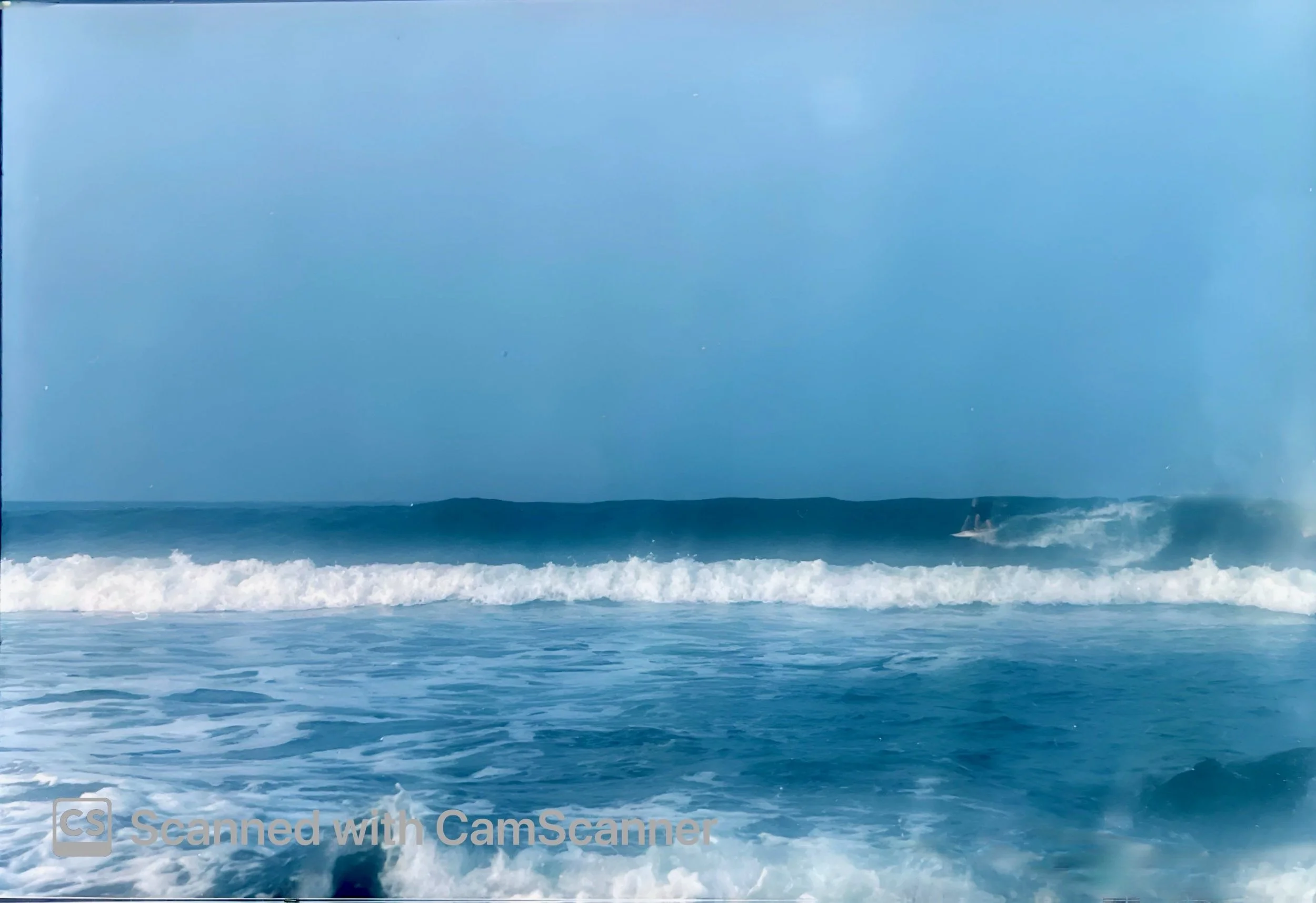
Me at Malpais at the start of the midsummer school holiday from which I never returned. Photo by a fellow exchange student.
After returning to the states, I did not take another trip to Costa Rica for 15 years! That's a story for another time. My dad had a house built on our property in 2007. Andrew moved there in 2008 to have a go at running a BnB en situ. I started graduate school in NY in 2009 and founded Conatus Surf Club in 2014. And that's when I started collaborating with Andrew to run retreats on our property. His business and mine, operating harmoniously (most of the time lol). Since 2015, I've taken 2-5 trips a year. Andrew no longer lives there full time. He got married to his wonderful wife, Tessa, and they live in Toronto most of the year. They spend 4-6 weeks on the property every winter. The rest of the time we run it as an Air Bnb through our amazing property manager, Natasha, with Redefine CR. It's completely stocked with surfboards, leashes, first aid (everything you need to help people surf better), a fully chef-equipped kitchen, and yoga deck for pre and post surf mobility overlooking the luscious secondary rain forest.
Getting There
Costa Rica boasts two main international airports:
Juan Santamaria International Airport (SJO) — in Alajuela, about 27 km from the country's capital city, San Jose. Gateway to the Central Valley, SW Pacific coast, and Caribbean.
Daniel Oduber Quiros International Airport (LIR) — in Liberia, closer to the northwest beaches of the Guanacaste region.
These airports serve as the gateways to surfing Costa Rica. To get to other specific destinations, some people may want to opt for the "puddle jumper" flights serviced by Sansa Airlines [LINK: Sansa Airlines website]. These serve smaller, domestic airports dotted all around the country, and you can sometimes shave a four hour trip into a twenty minute breeze by opting for one of these.
Domestic airports:
Limon (LIO) — Caribbean coast
Manuel Antonio/Quepos (XQP) — closest to Rancho Diandrew
Tamarindo (TNO) — Tamarindo beach area
Drake Bay (DRK) — southern Pacific zone (for surfing Pavones and Matapalo)
Tambor (TMU) — Nicoya Peninsula
Arenal (FON), Nosara (NOB), Tortuguero (TTQ), Puerto Jimenez (PJM), Golfito (GLF), Palmar Sur (PMZ), Carillo (PLD), Puntarenas (PRO)
These flights range from $60-$200 per person one way. If you have boards you'll want to contact them ahead of time, as the domestic planes are quite small.
To get to my property in the southwest, you fly into SJO. There are four main options for getting to the coast:
Rent a car in San Jose. Look for the best prices on Expedia and Kayak but then book directly with the business (this is the best practice for all sorts of travel). Don't side step the insurance. It's a racket but you do want it for ease of mind. Get a 4x4. Most of the country is paved, but there are still beaches and spots you do not want to be stuck in.
Take a smaller flight to Manuel Antonio/Quepos (XQP) (or whatever local airport is closest to your destination). You can either hire a car there (same advice applies), take a taxi to your destination ($50-$90), or you may be with a hotel that has shuttle service (we do not — you need to get a taxi to Dominical or Uvita where we'll scoop you). People surfing with me only need to hire a car if they want to structure their days more flexibly or stay off property.
Hire a private driver or shuttle ($60-$250 and a 3-4 hour drive) — many great options here. We have our private guy, Jonathan, and there are reputable shuttle services like Monkeyride.cr [LINK]. Any taxi driver trying to get your attention at the airport will drive you to any destination in the country. Your hosts will either pick you up at a designated meeting point or you will be driven directly to your destination.
Take a taxi from the airport to the central bus terminal ($35 and 20-45 minutes) and from there take an express bus to Uvita or Dominical (cheapest option at about $25 and 5-6 hours).
Driving in Costa Rica — Some Tips
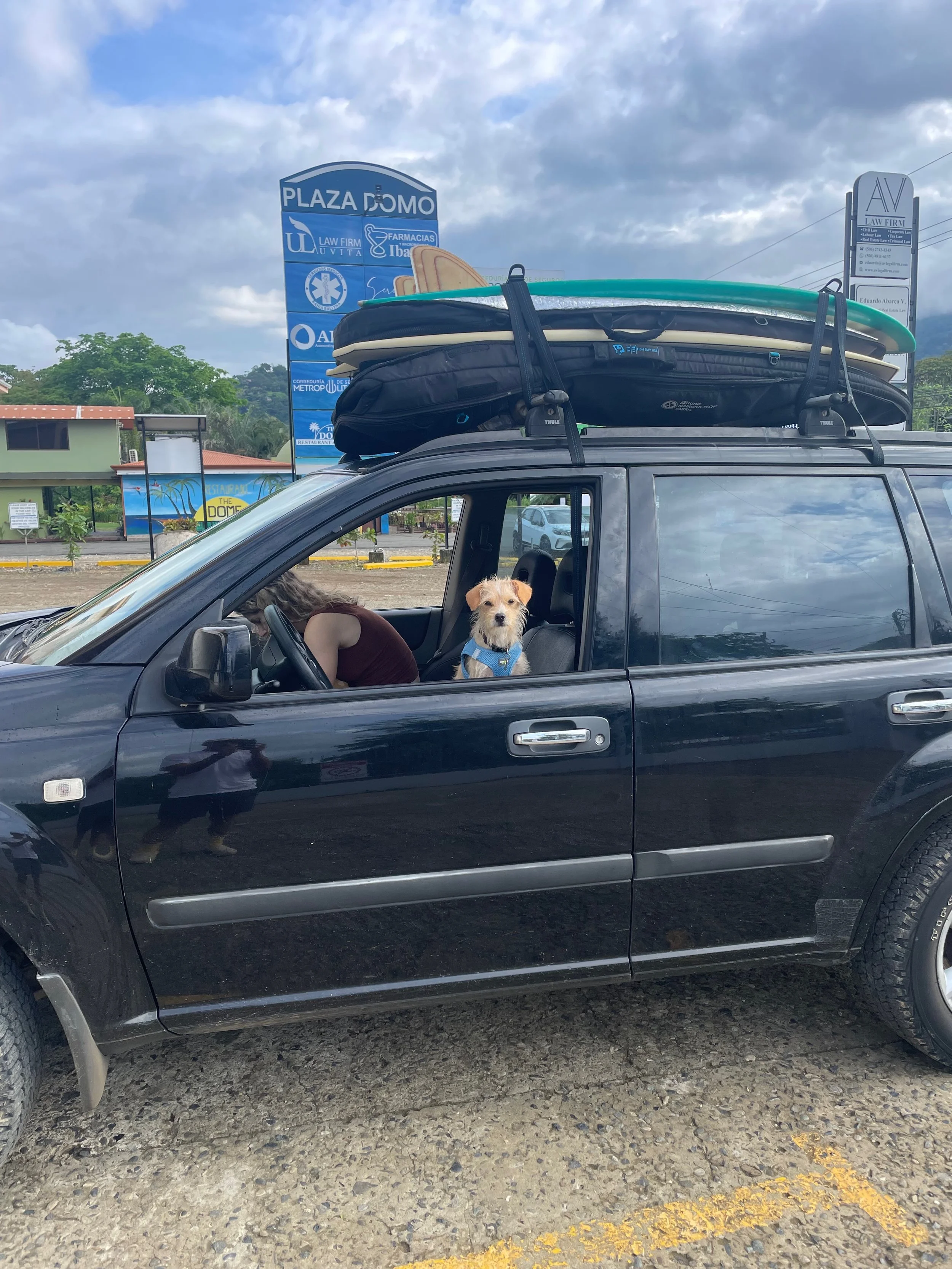
My Tica dog, Pita, knows the rules of the road!
Andrew likes to say, "There's only one thing more dangerous than the poisonous snakes in Costa Rica, and that's driving." Some of Costa Rica's main roads are exceptionally paved and well signed. They've come a long way in the past 35 years. But they've also only had decent highway infrastructure for less than that amount of time as well. That means there are many untrained drivers on the road. There is also a wealth and class gap that means that some people are driving 20 mph in a jalopy with their whole family in tow, and others are passing people around blind curves in new Toyota SUVs. You need to be on the lookout for both. The Pacific coastal highway, the Costanera, is a main route through central and south America, which means semi trucks galore. Again, some go the speed of a fast moving snail, others are freight trains from hell. You're going to need the stomach to pass the slow moving ones and the reflexes to stop short if one of the faster ones has jack knifed on the road ahead.
Quick rules of the road:
If you get in any car infraction, keep the vehicle exactly where it is. No moving it to the shoulder. Wait for the cops ("transitos") to arrive, report everything, and then you can be on your way.
There are cop stops on weekends and holidays where they check papers and cite drunk or stoned drivers.
Speed limit and seat belt policing are nowhere near as prevalent as they are in places like France and the US. Just try not to be a stupid dick.
Costa Rica has a few toll roads and they accept credit, debit, and Apple Pay at quick read booths. Scan and go.
Gas stations are readily available and most are open 24/7. I am not familiar with the EV landscape and charging ports.
The weirdest rule: a left hand blinker often means you want the person behind you to pass. I recommend also sticking your left hand out the window to signal that you actually intend to turn left.
Costa Rican vehicles are left hand drive.
Be careful driving in the rainy season. Downpours can be torrential and visibility can be negligible.
What To Know About Surfing Costa Rica
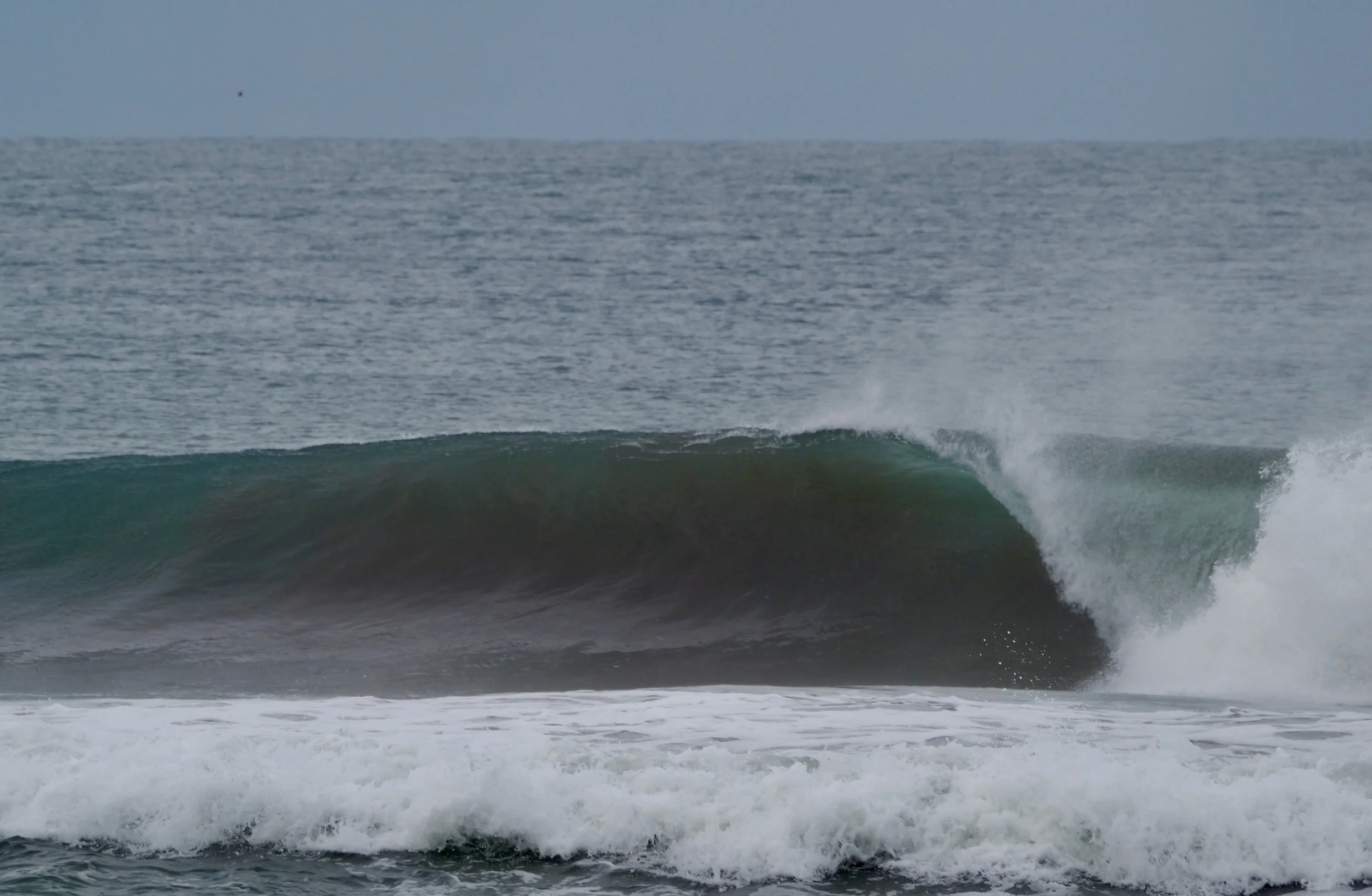
A makeable closeout tube at Playa Dominical.
General surf info:
Water temperature on both the Pacific and Atlantic coasts ranges from 79-85°F
Costa Rica is close to the equator — the water is hot and the sun is intense
Use tropical or base coat wax only
The most important surf equipment you will need is sun protection
Almost no need for any surf gear that protects against the cold
Recommended gear: surf hats, long sleeve rashguards, hooded rashguards, surf leggings (swim tights), board shorts, and all manner of women's bathing suits
I call the hours between 5-8a and 430-630p the "shirt off" sessions — the sun is not as intense at those times, so if you want to liberate yourself from the strictures of sun cream and protective gear, those are the times to do it
The rest of the time it's a good idea to cover up, especially if you have fairer skin (but let's be real, skin cancer affects everyone)
With a wide array of coastal features and exposures, there are locations to surf for every level, every time of the year. When you're choosing what boards to bring, that will depend on your level, and the time of year and zone you plan to visit. Locals are friendly, although I've heard of some rare localized zones (although never experienced them).
Climate
Costa Rica has three elevation-based climate zones:
Tierra caliente (hot zone) — sea level to ~500m. Coastal and northern plains. Daytime temps 77–90°F. Heavy rainfall in the wet season.
Tierra templada (temperate zone) — 500 to 1,500m. Central Valley, San José. Temps 65–80°F. Regular rains April through November.
Tierra fría (cold zone) — above 1,500m. Daytime 75–80°F, nighttime 50–55°F. Cooler, windier. Frost above 2,300m.
Obviously we're surfing in the tierra caliente. That's why no matter where you're surfing in Costa Rica, you need lots of sun protection.
Seasons:
Dry season: December through April
Wet season: May through November
Pequeño Verano: July and August — technically wet season but often a touch drier than the usually heavy rain months of June, September, October, and November
Caribbean exception: trade winds can bring rain any month, and the seasons are somewhat inverted
There is surf year round in Costa Rica. How much rain, wind, and swell you want to deal with will depend on which region you intend to surf, and at what time of year.
Main Costa Rica Surfing Regions
Guanacaste (NW Pacific / Liberia Airport Zone)
This is the northwest coast and features popular learn-to-surf destinations like Nosara and Tamarindo. It also boasts two of the more famous waves in Costa Rica: Ollies Point and Witches Rock, both made famous in The Endless Summer II. If you're planning a short vacation to the NW you will fly into Liberia. The climate is drier, hotter, and more arid than the rest of Costa Rica. The wind patterns are completely different than in the SW. The easterly (hard offshore) Papagayo winds blow from December–March and can reach 70 mph. The NW has a morning offshore and afternoon onshore wind cycle. Wind and tides, therefore, are both a factor in this region. It accepts all swell directions, with particular spots favoring specific directions. Ask your local surf guides or surf coaches to help you out here. Serves up reefs, river mouths, beach breaks, and rock points. There are sheltered spots for beginners when the swell is massive.
Nicoya Peninsula
Just south of the Guanacaste is the Nicoya Peninsula. This area features popular surf destinations Santa Theresa and Malpais. You're also likely to use Liberia Airport to get here, and it will be just a bit more of a hike than it is to get to Nosara or Tamarindo. This area has reefs and points, but expect more peaky and walled beach breaks. Spreads out the crowds. Tons of surf schools and coaches in this zone. Noted as one of the world's "Blue Zones" with some of the oldest and healthiest living people in the world. Weather is not as dry as the Guanacaste, and not as wet as the SW. Winds are more variable. A little lighter than the NW, and a little harder at varying directions than the SW. You will want to factor the wind forecast into your surf forecasting.
SW Pacific Coast
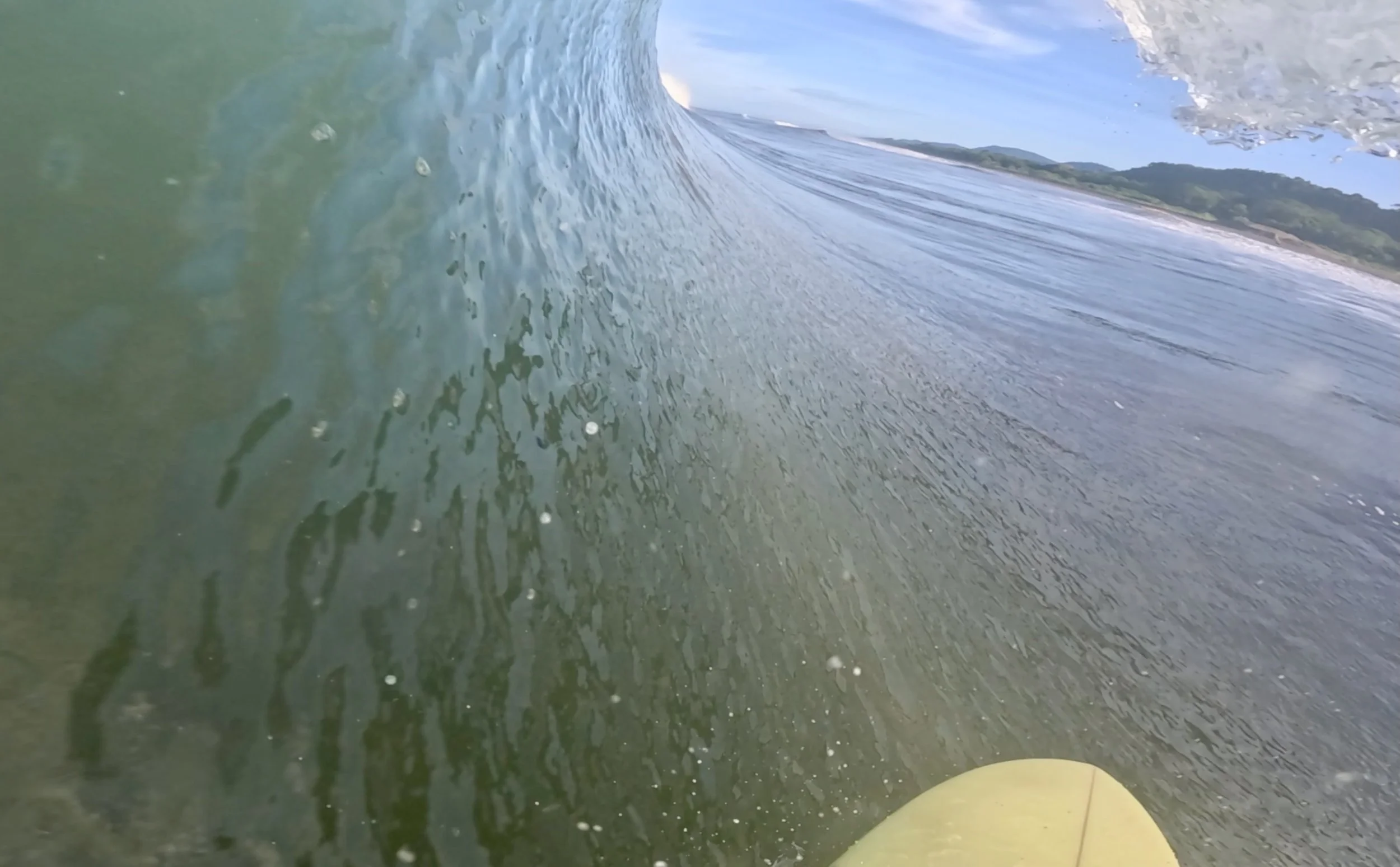
Low tide mornings at Playa Dominical offer views like this one. Great for surf coaching intermediates learning how to tuck in.
For this zone, you're flying into SJO and then figuring out domestic transport from there. If you're on a surf coaching trip with me, I will help you every step of the way.
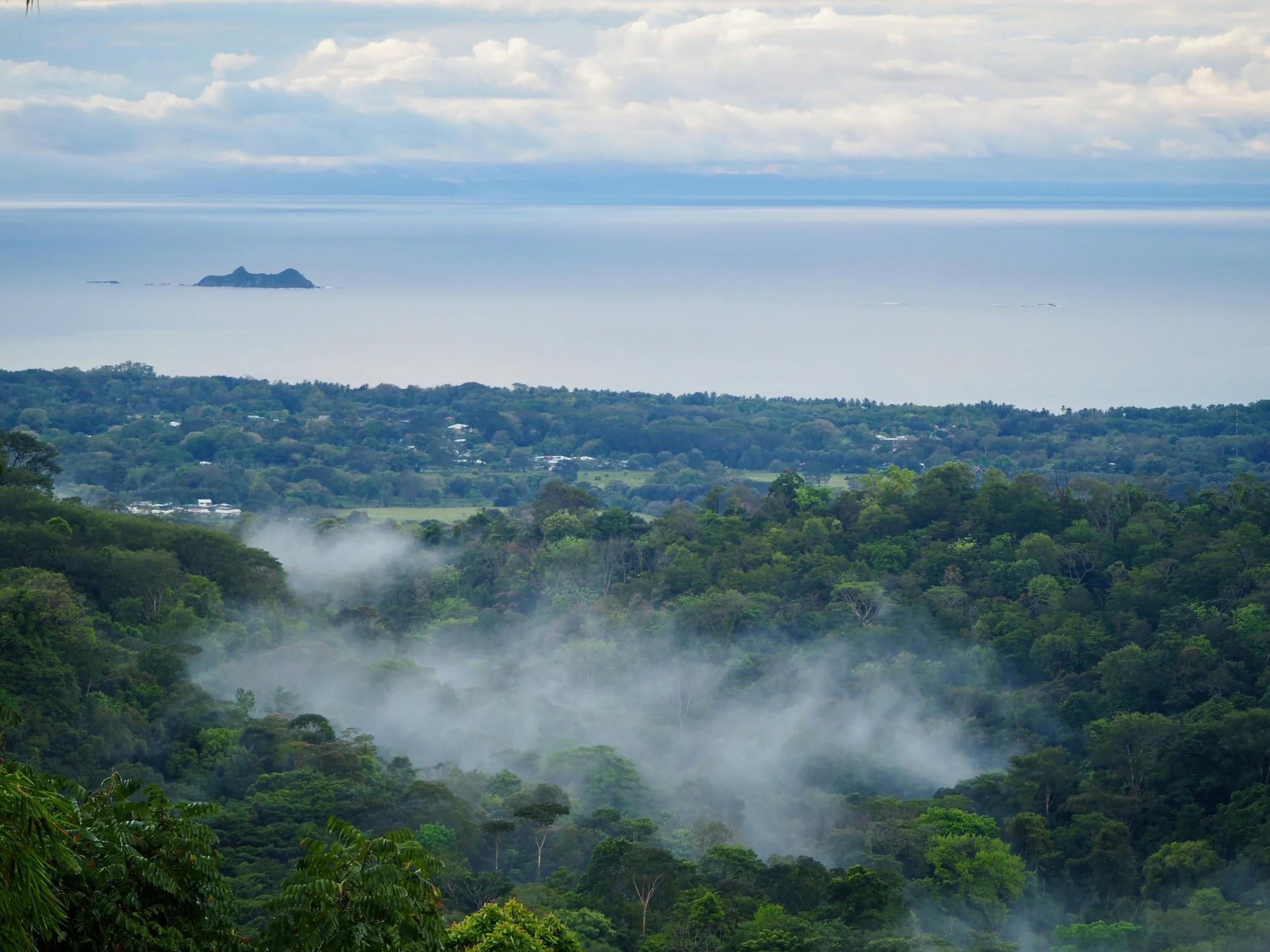
The view from our house, Rancho Diandrew, overlooking the rainforest that fringes the Rio Morete. The town of Uvita is there in the distance.
To access you drive west from SJO on Carretera 27 until you reach a little village called Tarcoles. There's a famous bridge there with dozens of saltwater crocs sunning themselves and waiting for anything to accidentally plop on the side of the riverbank. They clearly have an oath not to eat one another. There are little shops and bus stops and restaurants here.
The first big coastal town is Jaco. Good day stop if you need a new board in your quiver — main hub of the Costa Rican surf industry. Jaco is a famous party town. The beachbreak is absolute ass most of the time, but there are some amazing expert level reefs around there if you hire the right guide. I do not recommend staying in Jaco unless you like loud parties, cocaine, and prostitutes (and if this is your thing, you can get anything you want here, no judgment).
If you go to the right before Tarcoles, and not to the left, you'll enter the towns of Caldera and Puntarenas. As noted in my history, they have some good surf, and you can get the ferry to the Nicoya from the port of Puntarenas (yes, even with your car). The climate and winds in Puntarenas, Jaco, and Playa Hermosa follow the more moderate patterns of the Nicoya. Afternoon onshores are real and to be expected and factored in. Barranca likes a low tide and a decent sized south or southwest swell. The rest of the spots prefer mid to high and have their own favorite swell directions and intervals.
The next spot south of Jaco is Playa Hermosa (north). This has been a long time surf town with funky cafes, hostels, and swanky beachside bungalow type establishments dotting the highway, which is relatively close to the main beach. The "Puerto Escondido" of Costa Rica. A pretty punishing powerful beach break best at mid and higher tides. Beginners could ride reforms but you're probably better off in soft high tide closeouts at Jaco.
There are a number of hidden river mouths in between Playa Hermosa north down to Dominical. Saltwater crocodiles are a factor, so have travel insurance and a plan if you should spot or encounter one in the lineup. There's a rumor that the rivermouth at Boca Damas has one of the best sand tubes on earth and that Kelly Slater bought land there. It is also rumored that this is where Bruce Irons lost a pair of trunks when he didn't make it out of one particularly long, draining tube. I rarely surf this zone, preferring instead to get down to my property from SJO asap.
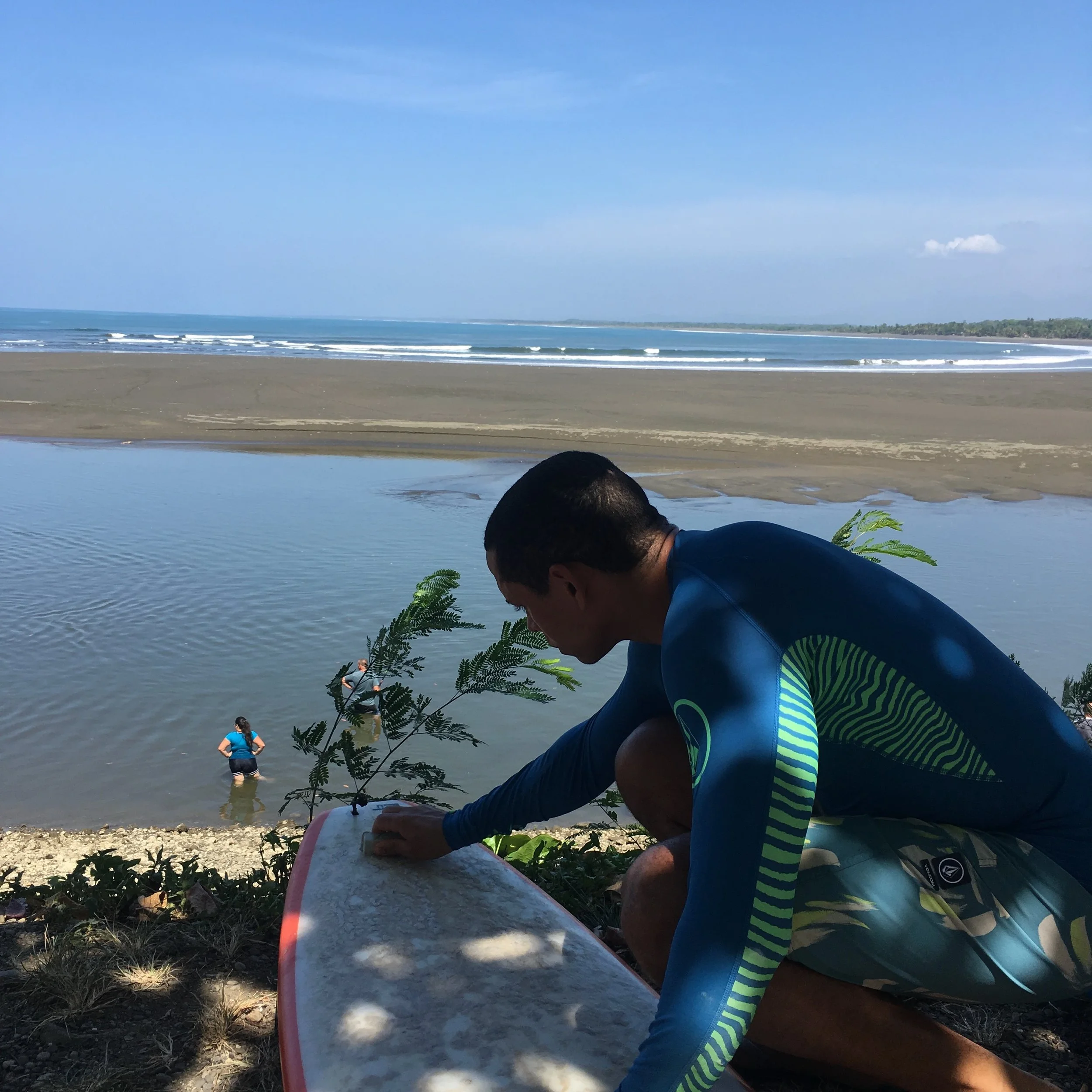
Mateo waxes up at Quepos Harbor.
Quepos Harbor is a gem of the central southwest. It's a reeling left sand bar that needs the largest of SW swells to turn it on. Great option for beginners looking to escape death closeouts and powerful tubes on the larger swells. Works only on low tide. Water is dirty due to its proximity to the local port. Some people are known to rinse off with hydrogen peroxide. I've surfed here a ton and never gotten sick or a rash. I rinse with normal water.
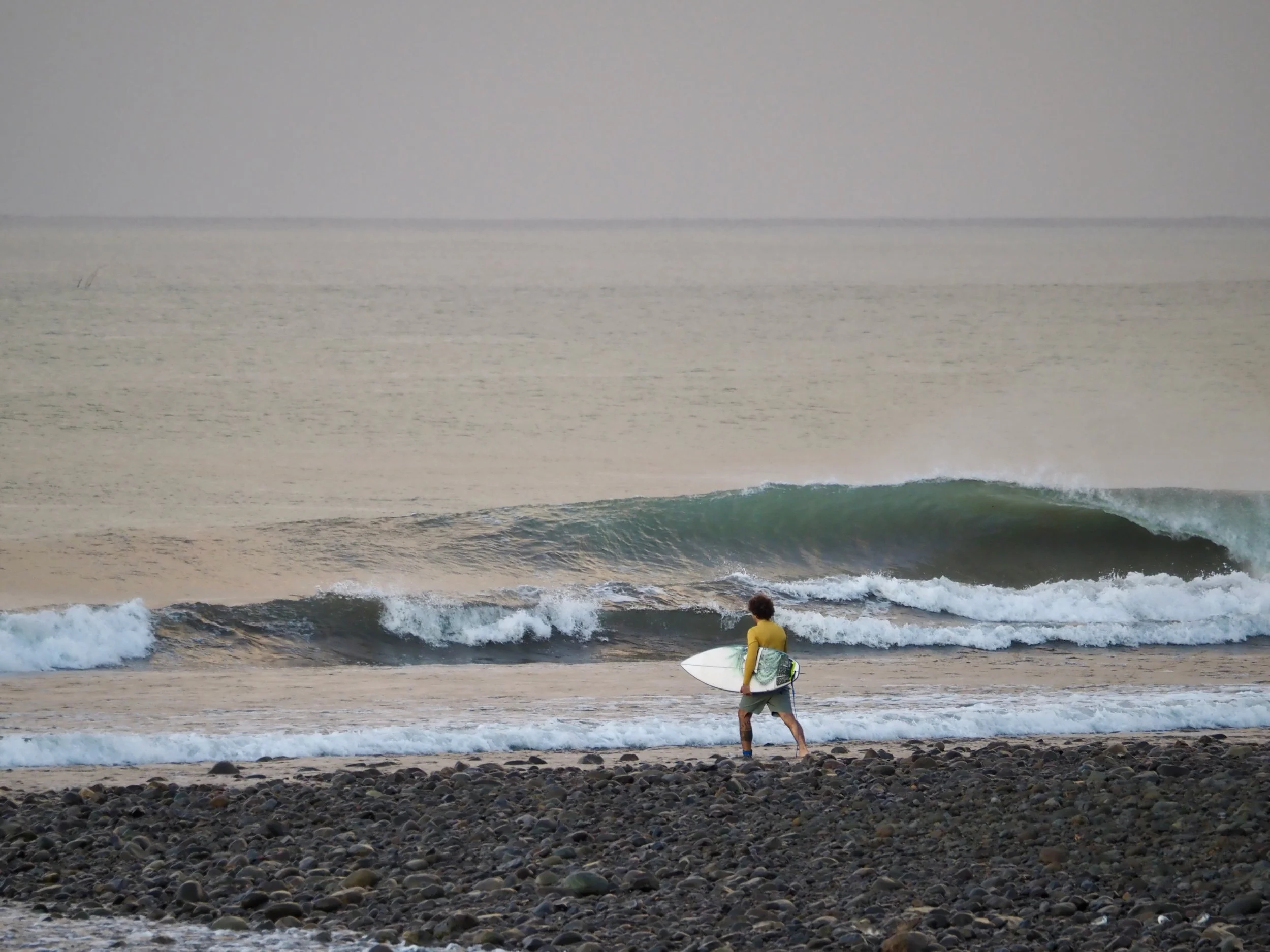
Germano and the stuff Costa Rican surf trip dreams are made of at the mouth of the Baru River in Dominical.
Dominical is about 45-50 minutes south of Quepos. It's a rivermouth beachbreak with waves on either side of the rivermouth and directly at its entrance. Sandbars are shaped by the river's currents, so local rainfall and run off patterns make a difference and vary year to year. Then there's about 2 km of peaky and sometimes closey beachbreak south of the river mouth. Dominical is an absolute swell magnet, so it's a great choice in the smaller dry season months when everything else is flat. Maxes out on large south swells. Like most beach breaks, loves lower interval combo swells.
South of "Domi" you have Dominicalito, a beginner spot, Punta Dominical, a funky reef break, and then Playa Hermosa (south). Playa Hermosa (south) is the closest break to Rancho Diandrew. We surf here a lot. It's a mid to high tide only beach break with very powerful A-frame peaks. No matter how small it is you will get caught inside by a rogue closeout set. Don't worry, there are lifeguards on duty. Great place to learn to duck dive, turtle, and manage your equipment. Maxes out on large swells. Likes small to medium, low interval combo swells. Practicing "foot shuffling" on the inside is recommended, as there are sting rays near the shoreline.
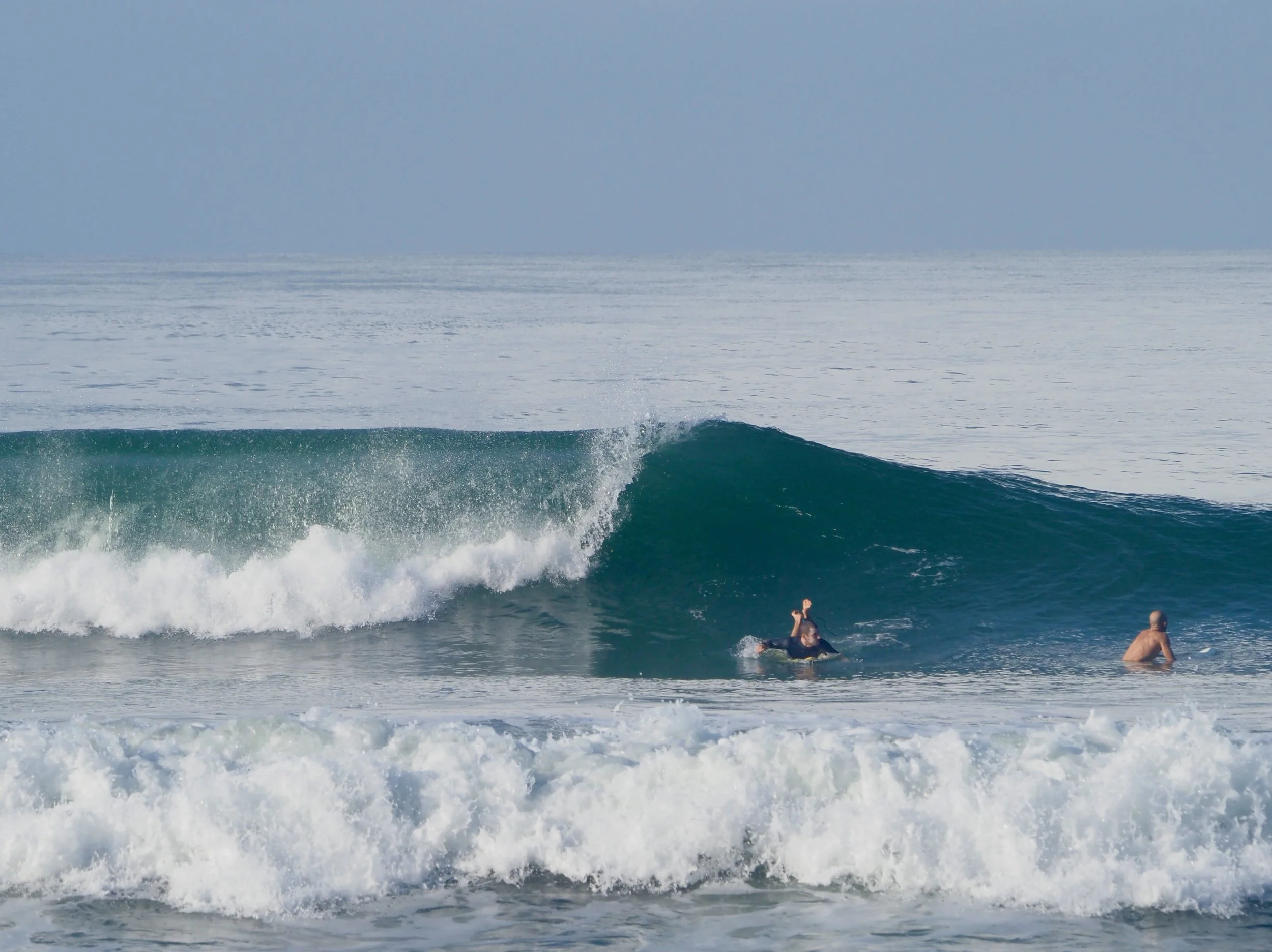
Carlos and me and sick peak at Playa Hermosa (south)
This is where I run most of my surf coaching trips. The variety of breaks within a 20-minute radius means I can match the conditions to whatever my students need on any given day — sheltered reforms for beginners, punchy peaks for intermediates, and heavy reefs for those ready to push it.
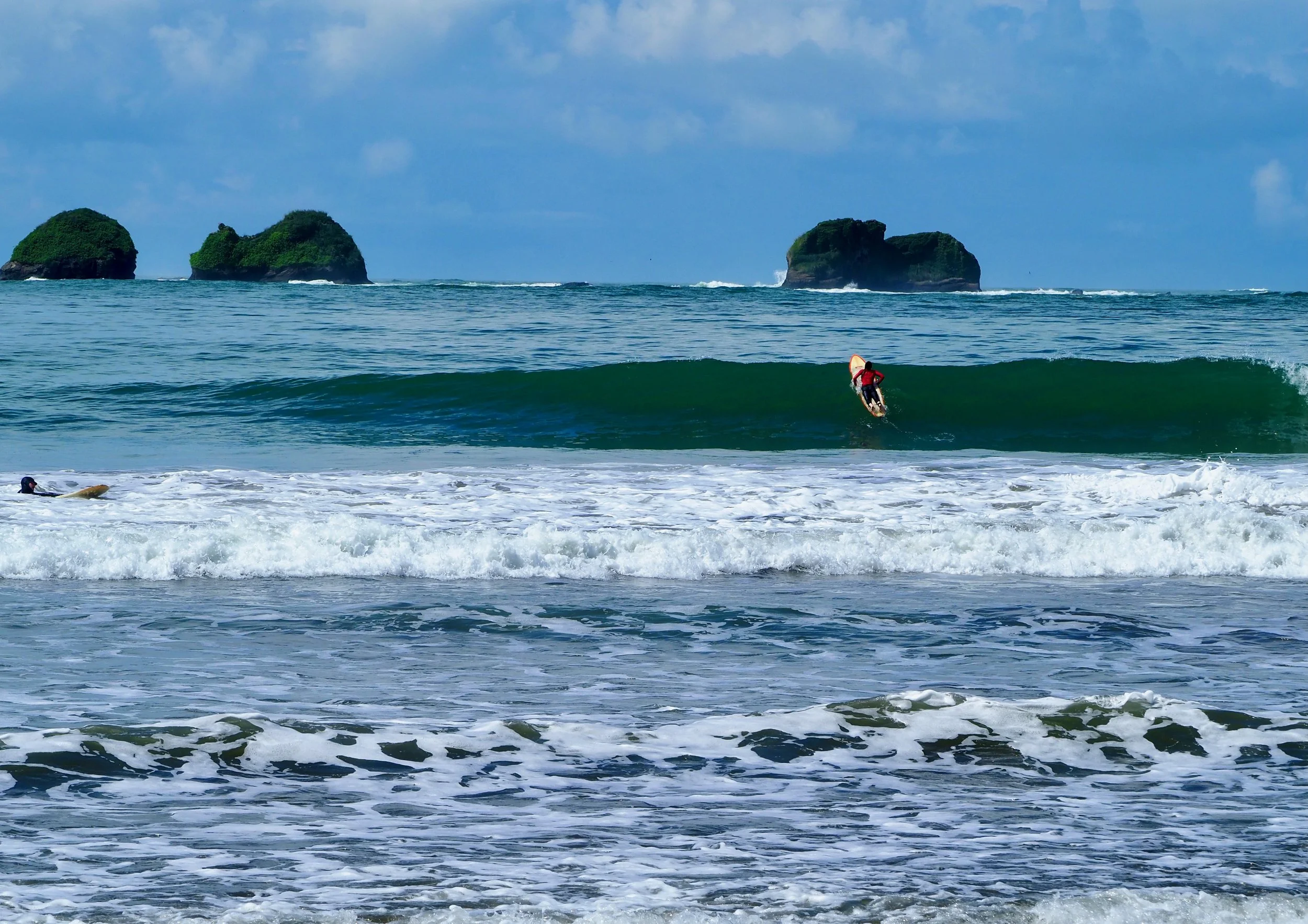
A fun wave south of Bahia Ballena near my property Rancho Diandrew.
There are many more waves south of Hermosa (south), most of them not significantly crowded or explored.
Winds in this zone are almost as predictable as swiss clocks: offshore or negligible from 530-8a. Then glassy for an hour. Then light onshore until 5p. Then glass again until dark (630p). Andrew calls them the "Pura Vida Winds." It's pretty much glassy enough to surf whenever the tide is right for the spots you're targeting. Even after the largest storms, you're bound to find 1-2 glassy windows.
Far South — Osa Peninsula and Pavones
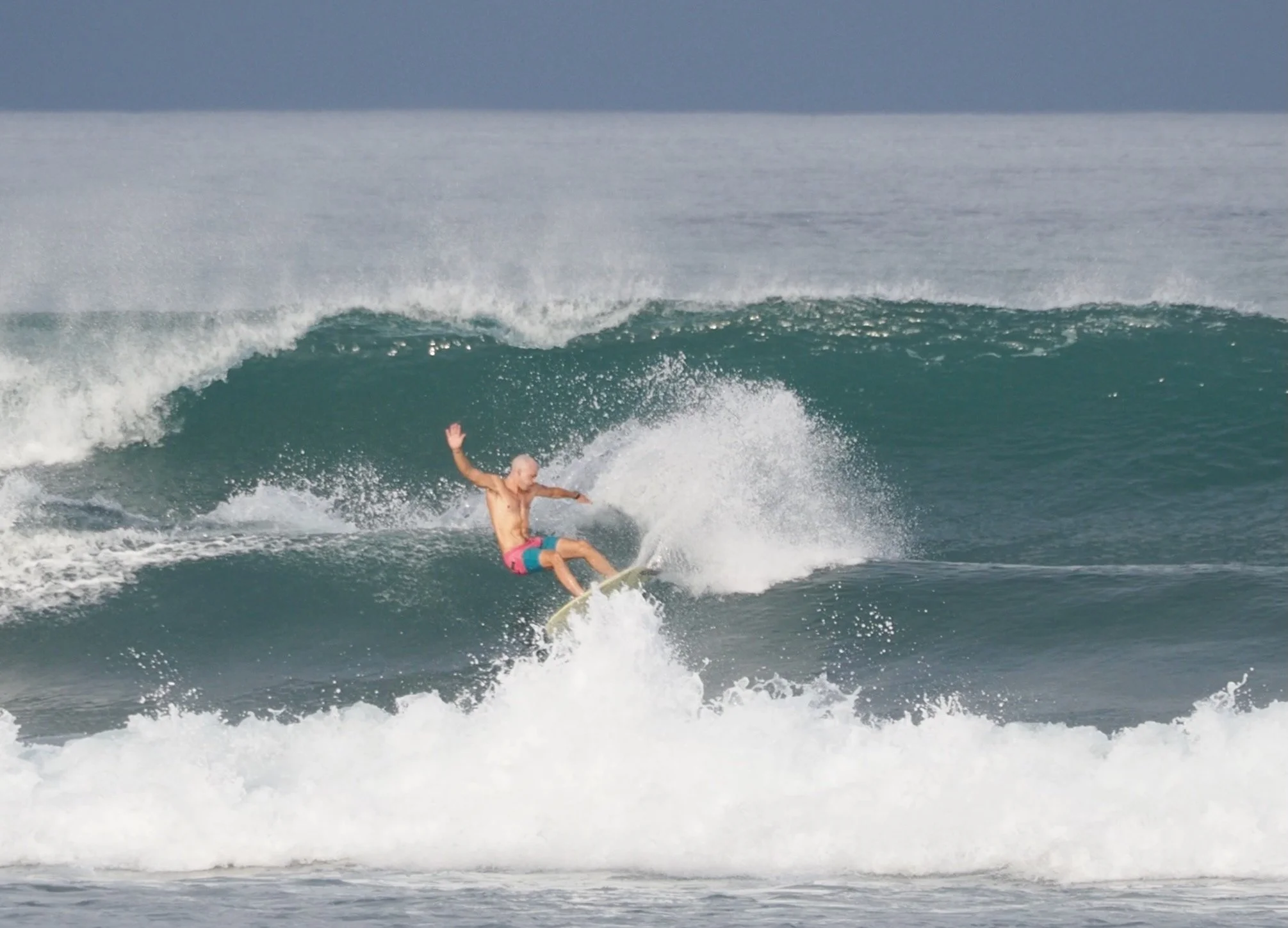
Pavones is fun at many sizes.
Do you like perfect left and right point breaks? Well this is where you go for that. There are a few rando beachies if you know where to look, but that's not why you come here to surf. The Gulfo Dulce is bordered by two fingers of land: Cabo Matapalo and the Peninsula de Osa on the north side, and the famed left cobblestone point, Pavones, on the south. It's possible to travel between the left and right hand points by boat, but the more common way is to pick a side. They break on relatively similar swell directions — big S or SSW or SW — and have options of heaviness and length, depending on whether the spot is set further out to sea or tucked into the bay. Surf schools and camps love those inner bay waves to teach learners almost regardless of swell size. If you're looking for surf coaching rather than a one-off lesson, this zone works well for multi-day immersion — long waves, warm water, and enough variety to progress through different conditions over the course of a trip.
The climate is different in Matapalo than Pavones. Matapalo is home to Corcovado National Park, one of the biodiversity hotspots. You will see macaws and monkeys in the trees while you surf. The roads are still awful by my last experience. Pavones and surrounding areas are closer to Panama and you see a climate shift there. It's a bit drier. There's still rainforest, but not quite like the luscious gushing one on the other side of the gulf. The dry cobblestones at Pavones on low tide evoke that scorched earth vibe. It is an incredible wave. Your legs get tired from doing so many turns. Beginners can surf the inside wave that goes into a small fisherman's bay. The town has everything you need for a surf trip.
There has, however, been political upheaval of the development variety in this zone. The Costa Rican government is reshaping Pavones by finding owners with "permit violations", razing their businesses, and repossessing the land for luxury development. I haven't taken a trip since this project began. It sounds shitty. Surfers will still find ways to access the wave.
Both Pavones and Matapalo are a short highway drive from Rancho Diandrew, but the roads into the surf spots have been a touch rough and slow going. I expect the road to Pavones will be finished before the one to Matapalo. How to get here: fly into SJO and take a puddle jumper to Golfito or Drake Airports. Or rent a car and drive the 7 hours from SJO. 4x4 recommended for Matapalo.
It can be very small and slow here in the dry season (December-April), but occasionally off-season south swells will sneak through. It is historically the least consistent and reliable time of year down there.
Caribbean Coast
I can't believe I still haven't been to the Caribbean! To be quite honest, I was made to be scared of it when I was in high school. Everyone told me that the theft and drugs were so out of control that it wasn't worth surfing there. Andrew recently took a trip. He loved it, but he did buy lockable surfboard racks specifically for that trip. It's not hard to understand. Drugs come in and out of the Port of Limon. Not that it's all bad. It's still Costa Rica.
Always warm and wet for eight months of the year. Experienced surfers may look to surf Salsa Brava, a below sea level, dredging right beast that almost drowned Taylor Knox. There are other reefs and beaches besides Salsa too, definitely something for every level can be found. Note: the Caribbean coast's seasons are somewhat inverted — February, March, September, and October are dry, while the rest of Costa Rica experiences heavier rains in September and October. For larger Atlantic swells you'll want to target September-March.
Culture is more Caribbean. Spices in the foods, reggae in the air, and Rastafarian color schemes. To get here you fly into SJO and either rent a car or take a puddle jumper, bus, or personal taxi to Limon.
What to Eat on a Surf Trip to Costa Rica
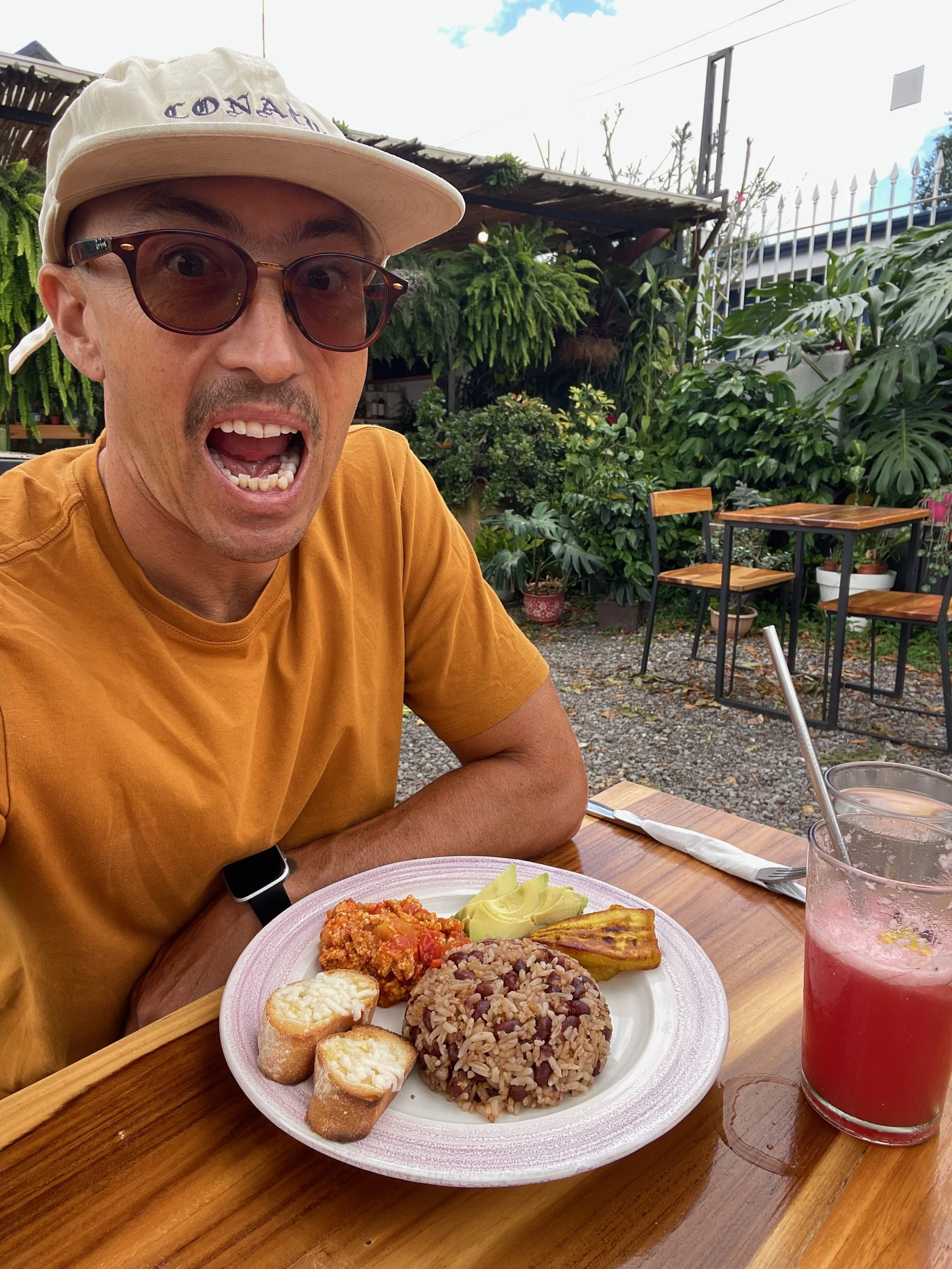
It’s easy to be a vegan in Costa Rica — here’s a plato tipico with Gallo pinto, toast, and tofu scramble.
Costa Rica is not a culinary destination by default. The standard fare is rice and beans, animal proteins, salads, and fruit. It's delicious whole food, but a lot of it has excess oil and very minimal seasoning. Two sauces you always want to take advantage of: Tio Pelon Salsa Caribeña and Salsa Lizano. Put them on everything.
For vegans and foodies, the Uvita/Dominical zone can't be beat. People came for the jungle and pura vida lifestyle and brought their culinary skills and traditions with them. The food scene is exactly as good as it should be. For those who enjoy plant-based cuisine, the Uvita/Dominical area stands out as a veritable vegetarian heaven on earth.
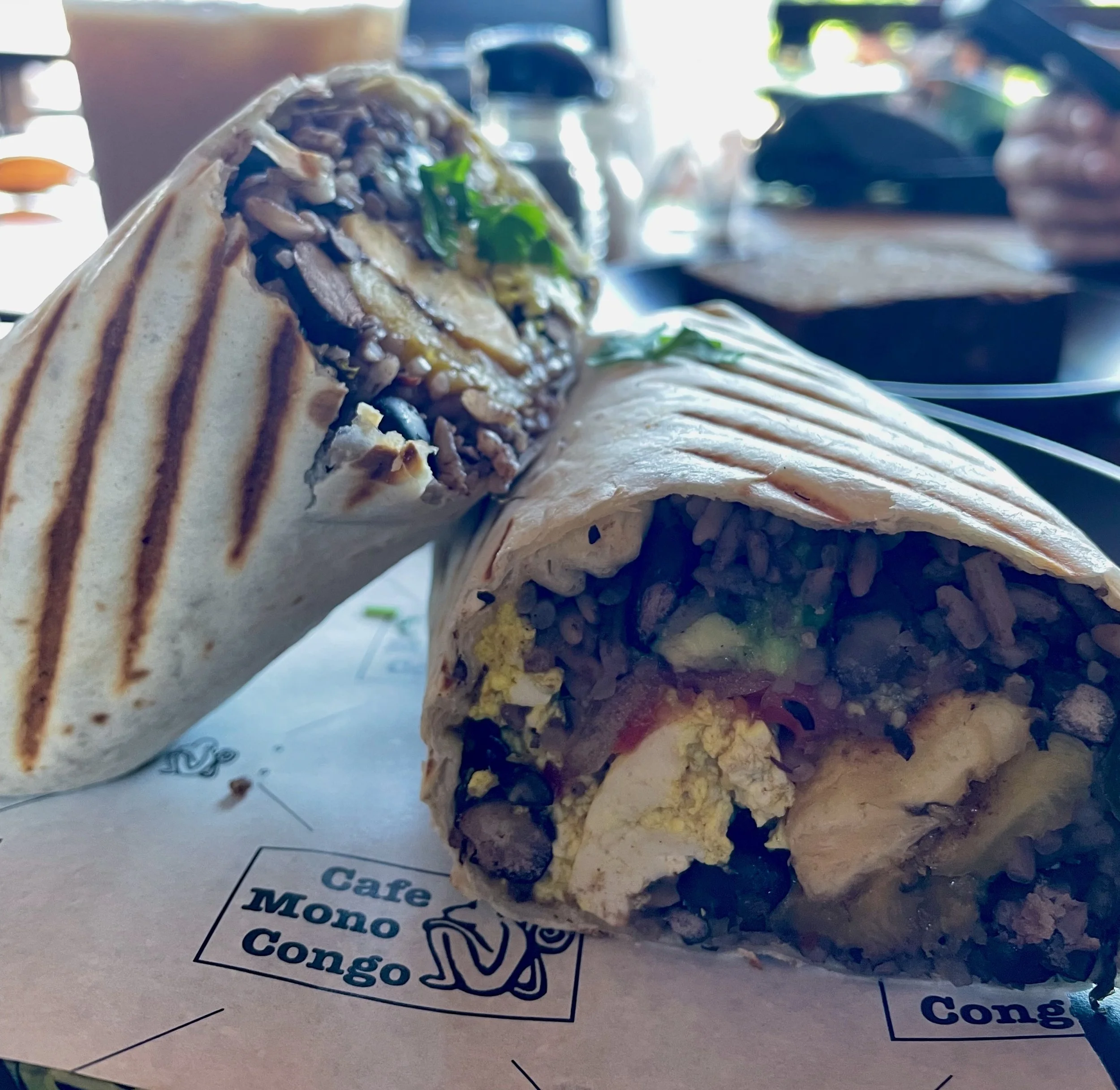
The Mono Congo vegan breakfast burrito can’t be beat.
The fresh, organic produce and Costa Rican-made protein and fermented plant milk products at Mama Toucans in Dominical are tried and true staples for home cooking. Next to Mama Toucan's is Cafe Mono Congo, which may have the best post-surf breakfast burrito on earth: gallo pinto, avocado, plantains, tofu scramble, and hot sauce, all wrapped tightly in a perfect tortilla wrapper. If you have a high metabolism like I do, it's nice to add a slice of their vegan banana bread and an iced coffee with soymilk to cap it off. The owners of Mono Congo, Shelby and Jo, also own Phat Noodle, a multi-dietary-pattern-friendly noodle joint serving only dinner. La Parcela is a great spot to watch monkeys and parrots — it overlooks the Point, and has food options for all dietary patterns as well, including vegan desserts.
In Uvita there are almost too many places to list. My favorite is Cafe Indomitos. They have a burrito that rivals Mono Congo's, but uses soy meat instead of tofu scramble. In the town center, Restaurante Maracuya puts vegan cheese in their patacones. And if you're looking for high, high end, take a trip up to Kura Resort and enjoy their plant-based menu and infinity pool.
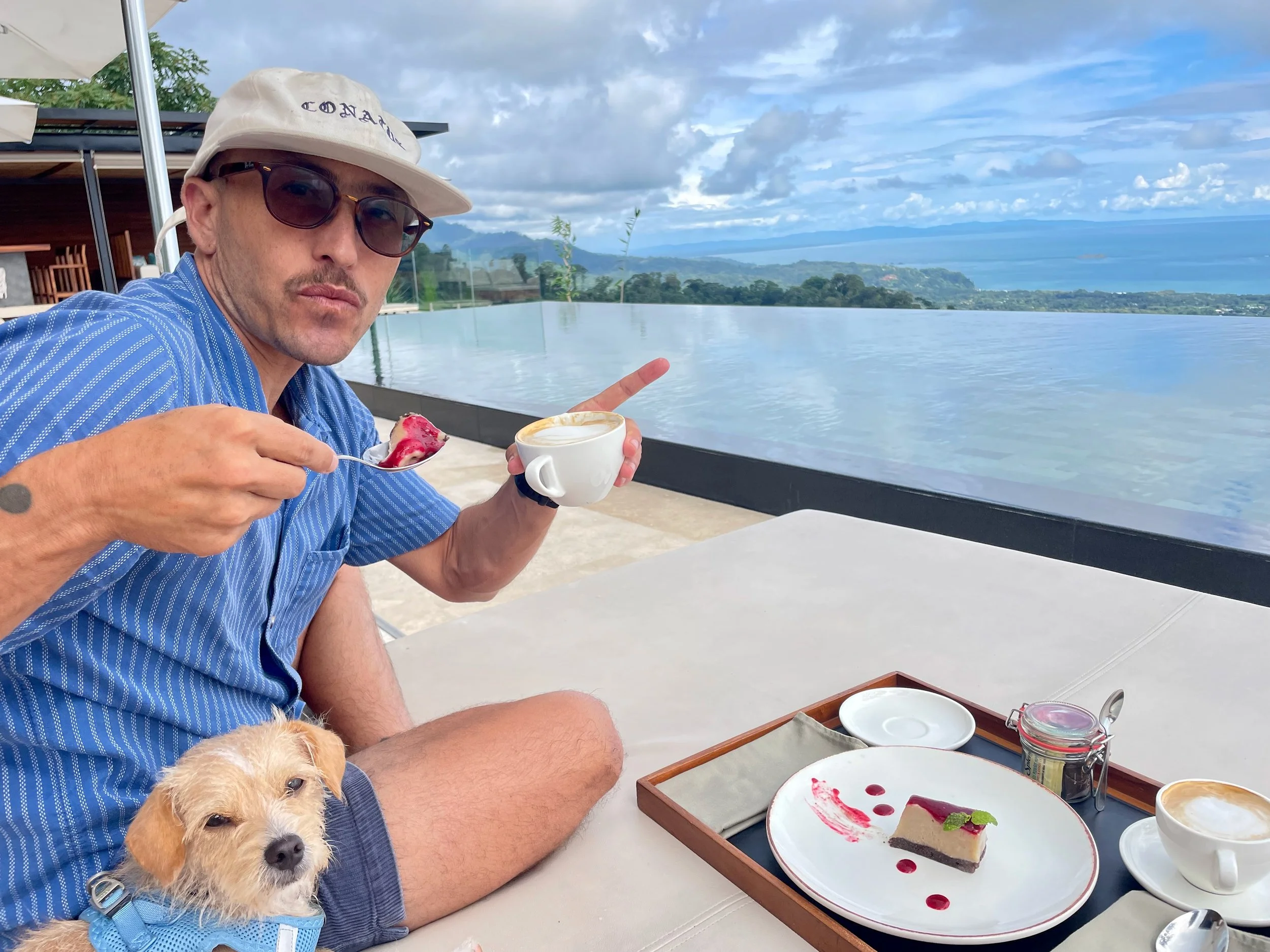
Exquisite vegan dining and chilling at Kura Hotel in Uvita.
A word on eating at home: most vegan food available in restaurants is vegetables with a starch, a starch, and another starch. The casados are delicious, of course, and one can live on starch, but the main reason I tend to cook at home on longer trips is because I know the central importance of protein in my diet, and I'm able to control for it. If you're serious about fueling your surfing — whether you're vegan or not — learning to cook simple, protein-rich meals from the incredible produce available at local markets is one of the best investments you can make on a surf trip.
Costa Rica Surf Trip Cost Breakdown
Any surf trip can be made more expensive by choosing upgrade and first class options. We'll just assume that's always the case. Some people are looking for the floor — how cheap they can possibly do it — and probably most people want something in the middle.
Airfare: $200-$5k depending on how close or far you are, international gas prices, and time of year — dry season (winter northern hemisphere) tends to be priced higher. Average roundtrip flight out of JFK in NY is $550.
Rental Cars: $30-$300/day depending on company, insurance level, and vehicle — to secure a 4x4 this should be one of your first to-do's when planning a trip.
Domestic travel (non-rental-car): $100-$1000 depending on how many spots you're planning to hit and what sort of travel combinations you use (puddle jumpers, private cars, shuttles).
Lodging: there are still $20-$30 a night hostels all over Costa Rica if that's your vibe. Air Bnb and VRBOs are plentiful in the $50-$5k (and beyond) range. All inclusive resorts are in Jaco, Limon, Golfito, Tamarindo, and Manuel Antonio (and other places besides). There are middle of the road surf camps and hotels in almost every popular surf destination. They often have meal packages and/or a restaurant attached to them and many others in walking distance.
Surf coaching and instruction: There's a wide range here depending on what you're looking for.
Tourist lesson (semi-private group day session): $50-$80/person
Surf coaching with me (all-inclusive, small group, daily video analysis): $3,500/week private, $3,250/week futon
Luxury surf coaching (e.g. Surf Simply): ~$10,000/week
You need to be real with your goals, your budget, and your vibe. If you just want to try it out and not go all in, the cheaper tourist lessons are the way to go. If you want results that last, surf coaching in small groups with video analysis is going to get you there most efficiently.
Equipment rental/travel fees: $0-$500 — airlines have gone way down on these fees in recent years. Remember: always say it's one board if they ask. Remember to pack your boards as lightly but securely as possible. For tips on board packing check out my YouTube video. You can rent boards for as cheap as $100/week. Ask local schools and shops. We offer free board rentals for guests of Rancho Diandrew— but if you break it or ding it, you pay for it.
Food: $10-$1000/day. Depends on how much you eat out. Rice, beans, veg, and fruit can support you if you're on the cheap.
Surfing Ability Levels
For my personal definition of ability levels please read the post What Level Surfer Am I? An Honest Self-Assessment and download the PDF to find out your exact level.
Pre-Beginners and Beginners — Costa Rica is a great place to start surfing (and many people do). Go whenever you have time in your schedule, but be sure to hire schools, camps, guides, instructors, or coaches. Surf coaching — where you work with one person over multiple sessions with video analysis — is going to give you the most durable results. If you're serious about getting better and not just trying it once, that's the path. The waves are powerful and during large swells you will need help accessing the smaller, more protected breaks. If you want to ensure the waves are small I recommend going at the beginning of the dry season December-February.
Advanced Beginners – Intermediates — don't plan a trip to Pavones or Matapalo in the dry season unless you're prepared to wait out flat spells, or surf it very small. Target the Guanacaste, Nicoya, or SW zones in the dry season, and everywhere, including Pavones/Matapalo, in the wet season. Your choice on whether you feel comfortable without guidance. You will get better at surfing and find better waves with surf coaching, and yeah, it might cost you a little bit more, but you'll have the results to take home with you.
Experts — you're going to score and you'll obviously pick the sorts of waves at the times of year you know will give you the best opportunities. I personally love Dominical at low tide in the mornings on a medium sized combo swell. Barrels galore any time of the year, but better sand during the wet season. If you're looking for toothy reef pits, the Caribbean should go off in the east coast hurricane season time of year (Sept-Nov). Roping left and right points, May-September the south lights up (and so does the rest of the west coast). You may not need surf coaching, but you may want guiding or to link up with a photographer/videographer to get footage of your sessions. There's plenty on offer. Feel free to reach out if you're looking for direction.
Costa Rican Culture Beyond the Surfing
Costa Rica is a Spanish speaking country. Most of the people you meet will also speak English. Increasingly I have found that they appreciate it more and more when you speak Spanish (if you can). There is a sense that even though they can speak English, we are visiting their country, and it is more respectful to speak Spanish there if possible. Learn a few key phrases.
Costa Rican Spanish is clear and slower than other types of Spanish. It does, however, have its own slang:
"Mae" — dude, mate
"Pura vida" — pure life. Functions as hello, goodbye, shit happens, and what a nice day, all at once
"Tuanis" — cool, "too nice"
Costa Rican culture is relatively formal, so default to 2nd person formal "usted" forms unless you really know the person. The second person informal pronoun is "vos" not "tu", so if you learned high school Spanish in the US, you'll want to change this. They can understand "tu", but they don't use it as much except in possessive forms, etc.
Money: Their currency is called "colones". $1 USD = roughly 550 Costa Rican colones. Consider a 1000 colones note to equal $2 USD. True exchange rates vary by day. ATMs and bank change fees are hefty, so bring up to $500 USD cash with you — they take cash — or just bite a one time $11 ATM fee and take out about 80,000 colones. That should be good. Most restaurants and services take electronic payment, including alternative forms like Paypal and Bitcoin.
Government
Costa Rica is a presidential republic that has sustained civilian democratic governance since 1949. It famously abolished its army that year. Presidents serve four-year terms and cannot run consecutively. The outgoing president, Rodrigo Chaves, will be succeeded on May 8, 2026 by Laura Fernández Delgado — the second woman elected president — who won the February 2026 election in the first round with 48.5% of the vote. Security is the dominant political issue: the number of criminal organizations operating in the country has grown from 35 to 340 over the past decade, and voters have shifted sharply toward law-and-order platforms. Costa Rica has also absorbed nearly 251,000 displaced people, primarily Nicaraguans fleeing political repression.
Is It "Safe"?
Petty theft still seems to be the biggest crime in Costa Rica, but there can be violent muggings and shootings too. Most of the serious crime is condensed in more populated urban centers. Costa Rica's homicide rate was 16.4 per 100,000 in 2025 — roughly 872 total homicides — up significantly from a historical baseline of 9.5-12.1 per 100,000 in the years prior to 2023. The increase is tied to Costa Rica becoming a logistical hub for the cocaine trade, with killings clustered around key trafficking zones. For context, the top crime districts are in central San José — commercial boulevards, bus terminals, markets, and nightlife areas. Expats and visitors in suburban, rural, or coastal communities typically have little contact with these environments. Costa Rica is undergoing a little bit more instability right now due to the ongoing crises in Venezuela, which has caused greater flow of migration through its southern border.
Targeted attacks on gringos are rare, but they do happen. In my experience any sort of flashy, expensive bling attracts thieves as obvious prey. This goes for staying in hyper-modern fancy Air Bnbs with infinity pools, which seem to be cased more often than humbler abodes.
My rule of thumb is: carry a machete in my car in general (both for thieves and snakes), and if someone wants something and you can figure out life without it, give it to them. Do not place valuables in an obvious place outside of your ability to watch them. You can buy a machete at many road side stalls or local markets if you're at all worried. We have only had to use ours to chop trails and cut down branches so we could video our surfers better. And at some places known for theft, it does feel good to have it with us.
Animals
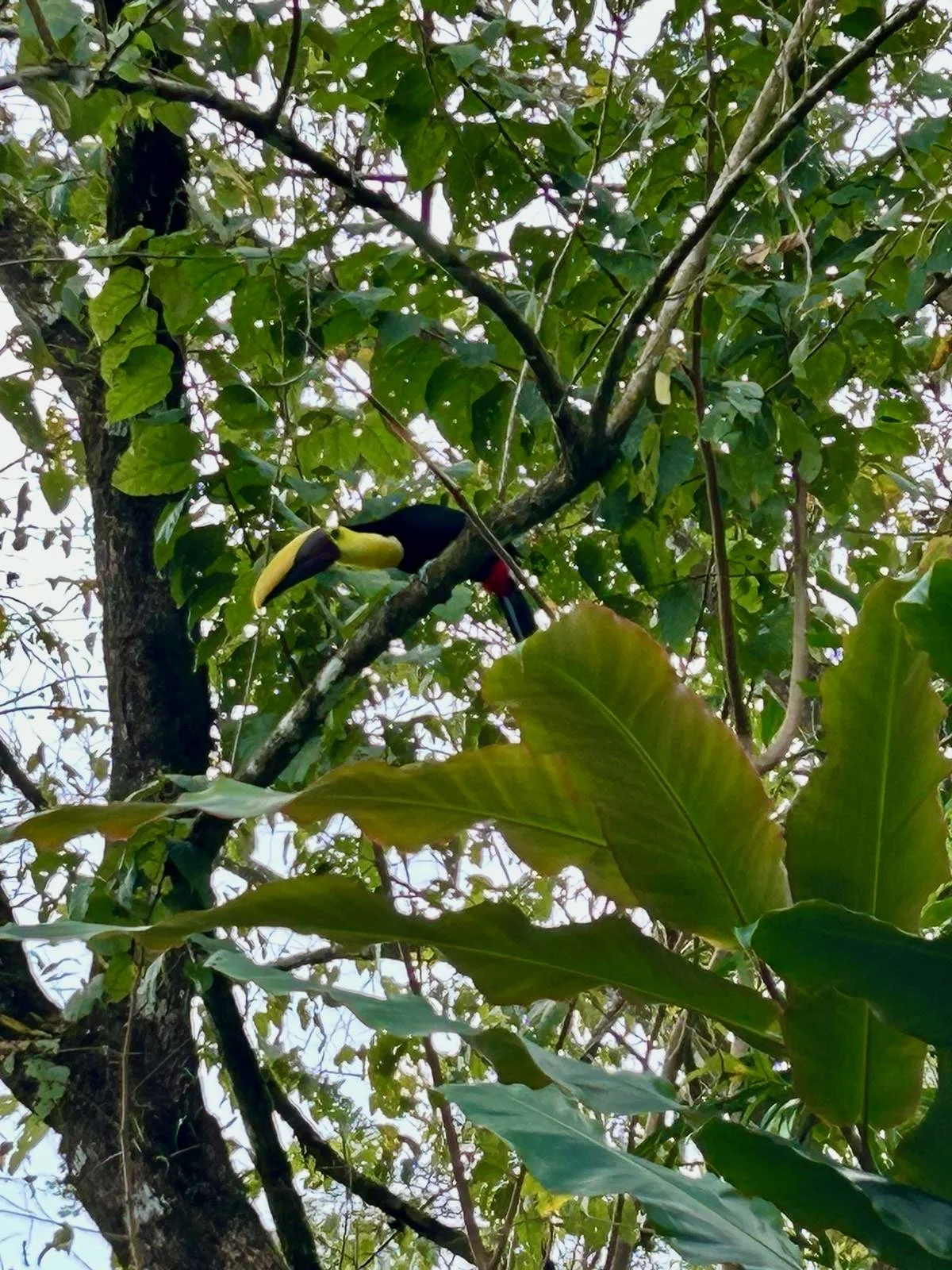
A toucan in the trees near the Rancho Diandrew yoga deck
Costa Rica is home to 441 species of amphibians and reptiles, 838 species of birds, and 232 species of mammals. Over 25% of national territory is in protected areas — the largest percentage of protected areas in the world. Almost half of the country's land is covered by forests. Despite constituting only 0.034% of the Earth's surface, Costa Rica's habitats represent around 5% of the planet's biodiversity.
Saltwater crocodiles and poisonous snakes (Terciopelo and Bushmaster) do exist in this zone, so you want to have your wits about you and be wary. For crocs it’s around creek and river openings. For snakes it’s piles of leaves and wood. If you see one: get the fuck out of there as calmly and as fast as possible. Back up slowly, and then when you’re at a good distance, run. I have never seen a croc or a poisonous snake. I have also never seen a great white and I grew up in northern California. That does not mean that I don't have a plan ready should it happen. Same for Tiger Sharks in Hawaii, etc. Every place has something. In Rockaway and many other popular breaks it's beginners not looking down the line when they take off. Probably scarier and more likely to be injured. For poisonous snakes you have to move quickly but not too abruptly. If they lunge at you, you do not want to chop off their heads with a machete, but bang them on the top of the head with the flat bit so they are stunned. Always look under cars with a flashlight at night before you get in. They hang out under things. Mortalities from snake bites are now very rare in Costa Rica. If you are bitten, go straight to the nearest clinic.
In the SW every manner of creature abounds. Costa Rica will eat you and rejuvenate you at the same time. That's what it's doing all the time.
If you have any questions about surfing in Costa Rica — or anywhere else I coach — don't hesitate to reach out. If you're interested in one of my all-inclusive surf coaching trips (all levels welcome), book a Surf Journey Assessment call. The $99 assessment fee is applied as a credit toward your trip. I handle all travel and lodging logistics once you're booked. Let's get you in the water.