
I watch surf contests. I see the ads. Pro models are sexy. The people riding them rip. And then I go surfing, and I see people on those same shortboards who can't paddle, can't make a drop, can't turn. They've skipped a massive step. They may have never been on a longboard — it certainly doesn't show in their surfing. They simply can't ride green waves, and they're on boards meant for radical, slicing maneuvers.
I also see people on fancy mid lengths with no rocker in hollow, tubing surf — nose diving every time. They can get into the wave, but the board can't handle the transition. Wave too curved, board too flat. Face plant.
There's a step being skipped over. It's the advanced beginner stage — not sexy, not new and exciting the way the beginner stage is, but bridgeable. There are two boards that get you from where you are to the kind of surfing you actually want to do: the egg and the hybrid. I use both with my clients and surf both regularly. This post covers both.
This is ultimately about desire and perception. It is good to want to be a solid, smooth, stylish surfer who can duck dive, surf any board, and perform a decent variety of maneuvers. And it is achievable. But you will set yourself back if you skip big boards altogether, or go from long to short without a step-down phase.
What is an advanced beginner surfer?
An advanced beginner surfer rides the green face of a wave consistently but hasn't yet cracked the duck dive. Duck diving is the milestone that marks the transition to intermediate — you are not intermediate until you can do it. If you're still on a longboard or foam board and can't duck dive yet, the boards in this post are your next step.
You are also two boards away from a shortboard — if a shortboard is even your goal. It doesn't have to be. Smooth and clean is a worthy destination in its own right. Radical ripping is largely available to people who learned as kids. Adult learners who pursue smooth, controlled, stylish surfing are chasing something real and completely achievable. Don't let surf culture's fixation on pro performance set the terms for what counts as success.
Not sure where you fall? What Level Surfer Am I? An Honest Self-Assessment is worth reading first.
Resist the Urge to Fetishize Pro Shortboards
There's a basic fetishism at work in surf culture — and I mean that in the technical sense. The hero has magic powers. The hero's magic powers are connected to her surfboard. If I ride the hero's surfboard, I will have magic powers too.
It doesn't work that way. And the board building industry, which does need to sell boards, isn't helping matters by marketing pro models to people who have no business riding them. The reality is that high performance shortboards make most advanced beginners surf worse, not better. The board is too sensitive, too unforgiving, and too demanding for the skill level operating it. The object has power, but it needs the person riding it to have as much power as it does.
I was doing roundhouse cutbacks on a 7'2" before I ever stepped onto a 5'8". The sequence matters. Skipping it doesn't accelerate anything — it just puts you on a board that exposes every flaw in your surfing while removing your ability to catch waves in the first place.
If you can't confidently say "I can perform a full roundhouse cutback on an 8'0" in two foot surf," high performance shortboards are off limits. Or they ought to be.
What this board needs to do
The best surfboard for an advanced beginner should float well, paddle efficiently, and allow turns. It should be lighter than a longboard. Duck diving is directly related to board volume — more volume means more board to push underwater, which is why duck diving in this size range is genuinely hard, especially for lighter surfers. But that's the work. That's the point.
How big and what shape depends on where you sit and how much you weigh. Board collecting is genuinely fun if you can afford it, and plenty of surfers end up with a small quiver as their surfing develops. But this first step-down board should be right.
What to watch out for when shopping
When shopping for this board, avoid mid lengths with wafer-thin pinched rails or completely flat rocker. Pinched rails demand precision that advanced beginners haven't yet developed. Flat rocker requires a very precise takeoff and will cause the board to pearl in hollow surf.
The mid length category is where most advanced beginners end up looking, and it's the right instinct — but there's a way to make a mid length completely unapproachable for anyone short of an advanced surfer. Watch out for wafer thin, pinched, sensitive rails. Watch out for completely flat rocker — it sounds forgiving but it means the board requires a very precise takeoff or it will pearl.
The other mistake I see constantly: fishes and pro-style shortboards with not enough vertical rail line. These boards are too short and too sensitive for surfers who are still working out their stance. A board that's too short amplifies every imbalance in your surfing rather than giving you the platform to work through it.
A note on duck diving
Duck diving a board in this size range is hard, but doable when the technique is right. If you're a lighter surfer it's especially hard — what I can push underwater at 145 lbs with solid form is a different proposition from what my brother Andrew can do at 210. Learning it on this board is the point. Watch this for how it's done on a board in this size range.
The payoff: when you eventually step down to something smaller, the duck dive on that board is going to feel like nothing. You've done the harder version. That's the work paying off.
Don't make the mistake of downsizing primarily to make the duck dive easier. An advanced beginner who does that ends up on a board they can't paddle into waves — trading one problem for a worse one.
The two boards: egg and hybrid
Both the egg and the hybrid are mid length shapes. Both are valid paths for advanced beginners. I use both with my clients and surf both myself. The choice between them comes down to body type, growth trajectory, and personal aesthetic — not one being objectively better than the other.
The Egg
The egg is a rounded, fuller-nosed mid length with a more retro aesthetic. It maintains paddle power while reducing overall board liability — smaller and noticeably more maneuverable than a full longboard, but still plenty of float. Smaller surfers and smaller women in particular tend to gravitate toward eggs, and for good reason: they're easier to manage without sacrificing the ability to get into waves.
Duck diving an egg is harder than duck diving a hybrid — sometimes doable with the right technique and sufficient weight, sometimes not. It's not a dealbreaker, but it's worth knowing going in.
Who chooses the egg: surfers on a slower growth curve, surfers who prefer the rounder nose and retro feel, and surfers who want to reduce board size without giving up paddle power.
My egg recommendations: The entry point into this category for someone coming off a longboard is an 8'3". It's a smaller longboard in practice — noticeably more maneuverable and easier to carry, but still enough board to paddle with confidence.
My personal eggs: in New York I ride a 7'3" Fineline and an 8'3" Barahona. In Costa Rica I ride a 6'9" Josh Hall and an 8'3" Barahona. The Fineline and the Josh Hall are boards I genuinely love riding for myself. The Barahona eggs are workhorses — excellent across a wide range of surfers.
For fin setup: 2+1, single fin, or thruster all work on eggs. Single fin keeps it retro and will do the job.
The Hybrid
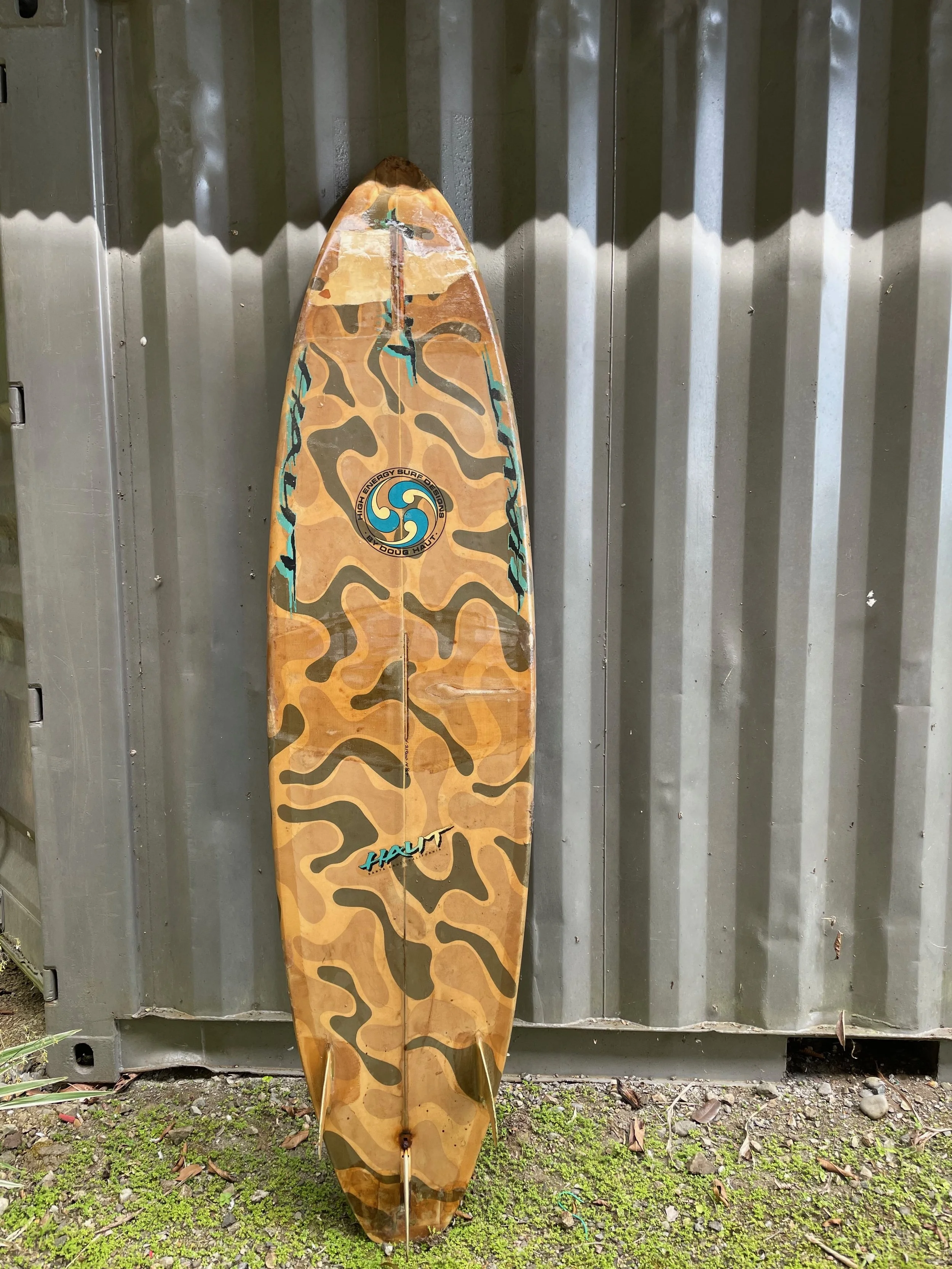
My dad’s 7’2” Hybrid by Doug Haut. This is the board I caught my first green wave on.
The hybrid draws from longboard, shortboard, and fish designs without being any one of them. That's what it will be called in shops and by shapers all over the world — not a shortboard, not a longboard, not a fish, but drawing from all of them. When you walk into a shop and ask for a hybrid in those dimensions, you'll be understood. It's also sometimes called a "big guy shortboard" — historically shaped for heavier riders who needed float and paddle power in a shorter template.
What makes this shape work for bigger surfers is exactly what makes it work for advanced beginners: volume where you need it, enough rocker to handle real waves, rails that allow turning without demanding expert-level precision.
Platonic ideal dimensions: 6'4"–7'8" long, 21–22" wide, 2.5–2.75" thick. Where you land depends on your size. These boards work incredibly well in tiny surf if you're a lighter rider. If you're heavier and the surf is gutless, this board isn't the answer — get back on a longboard.
On fins: I ride mine as a thruster. It will work with a quad or 2+1, but the thruster is clean and removes decision fatigue you don't need at this stage.
What this shape demands from you is also what makes it so effective. The volume gets you into waves early, giving you time to set up the ride rather than just survive it. It will keep your surfing smooth and demand that you learn to use your legs. And the rails have enough sensitivity that you can start pushing much harder than you ever could on a longboard.
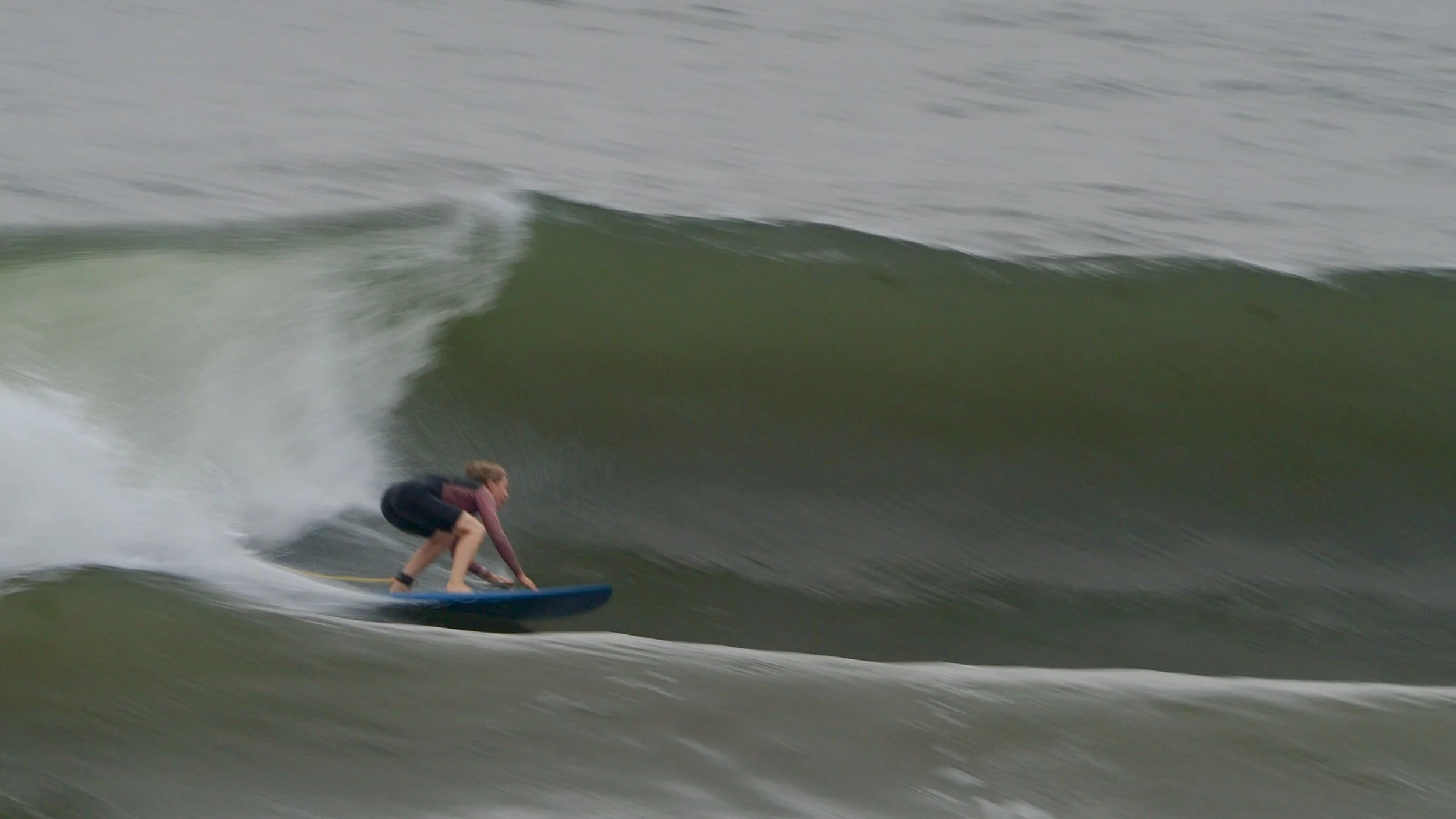
Client AnnieWeinmayr on her custom 7’6” Barahona pushing hard off the bottom in NY.
Who chooses the hybrid: surfers who want to push harder sooner, surfers who prefer a more performance-oriented shape, and surfers who want the clearest path toward eventually going smaller.
My hybrid recommendation: My number one is the Tiburon by José Barahona. I've been working with José on these boards for ten years and I've seen the results across a wide range of surfers. He executes this design flawlessly. I have two — a 7'6" in Costa Rica and a duplicate in New York, mostly for clients. I ride them for content and to demonstrate what the board can do. To this day the best barrel I've ever had in Rockaway was on the 7'6".
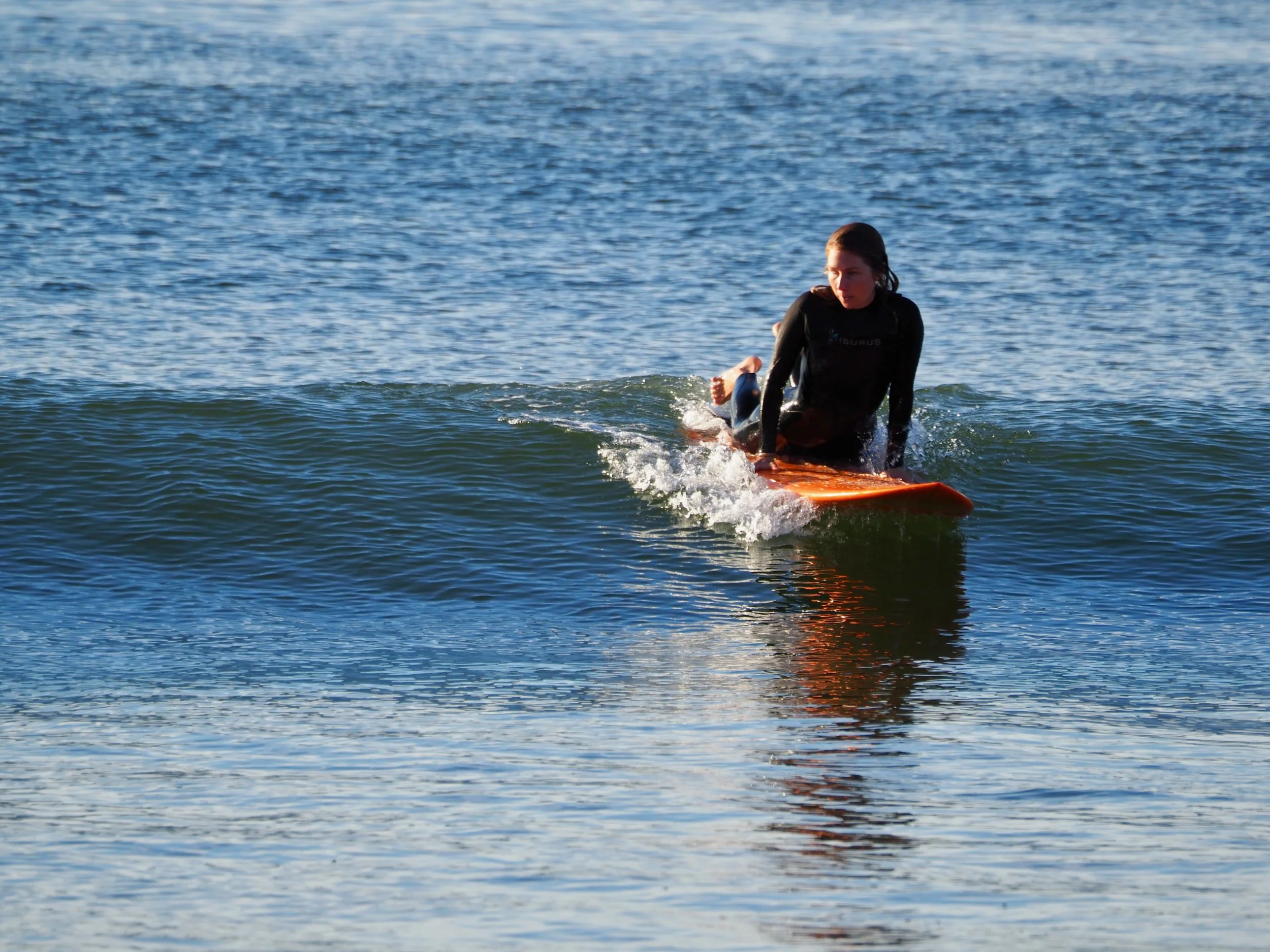
MG Bruno slides in early on the 7’6” in NY.
It has everything the shape demands: float, rocker, 60/40 rails, and a pulled-in tail that allows real turns. An advanced surfer can get on it and have fun. A true beginner will find it inaccessible. Advanced beginners are exactly who this board is built for.
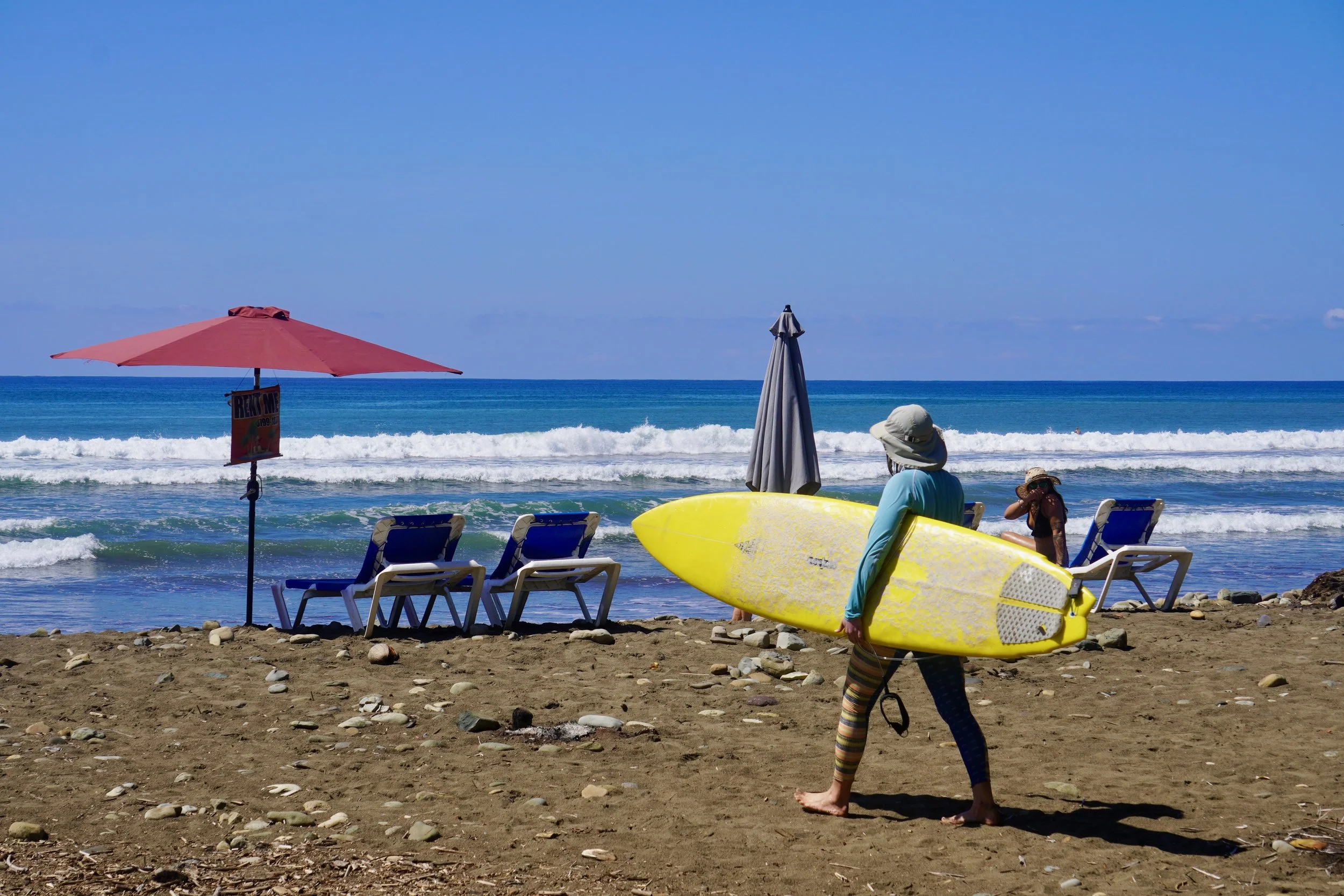
Charlotte Schmidlapp taking the yellow 7’6” out in CR.
Other shapers who understand this template well are Bob Pearson (Pearson Arrow Surfboards) and Rusty Preisendorfer (Rusty Surfboards). What you're shopping for is the combination of properties, not a logo.
The payoff
The step down to a smaller board is supposed to feel like a reward, not a starting point. Once you can bang sections, get tubed, and duck dive a board in this category, stepping onto something smaller is a completely different experience. The smaller board feels alive under your feet in a way that makes sense, because you've built the foundation that lets you feel it. That's the sequence working as designed — a totally earned achievement.
Frequently Asked Questions
What size surfboard should an advanced beginner surfer ride? An advanced beginner should ride either an egg or a hybrid in the mid length range. Eggs typically run 7'3"–8'3" for this level. Hybrids run 6'4"–7'8" long, 21–22" wide, and 2.5–2.75" thick. Exact sizing depends on body weight and where the surfer falls in the advanced beginner range.
What is the difference between an egg and a hybrid surfboard? An egg has a rounder nose, fuller outline, and more retro aesthetic. A hybrid draws from longboard, shortboard, and fish designs — more performance-oriented with a pulled-in tail and sensitivity in the rails. Both are valid choices for advanced beginners. The egg suits a slower growth curve or retro preference; the hybrid suits surfers pushing toward more performance-oriented surfing sooner.
Do advanced beginner surfers need to know how to duck dive? Duck diving is the milestone that marks the transition from advanced beginner to intermediate. Both the egg and the hybrid described here are where that skill gets built. Duck diving a hybrid is hard but doable with good technique. Duck diving an egg is harder still — sometimes doable depending on weight and form.
Should advanced beginner surfers ride a shortboard? No. As an advanced beginner you are two boards away from a shortboard — and that's only if a shortboard is your goal. High performance shortboards require precision and technique that advanced beginners haven't yet developed. Riding one prematurely exposes every flaw in your surfing while removing your ability to catch waves consistently.
What fins should an advanced beginner use? On a hybrid, a thruster setup is cleanest — reliable and removes decision fatigue. On an egg, 2+1, single fin, or thruster all work. Single fin keeps the retro feel of the shape.
When should an advanced beginner move to a smaller board? When you can consistently duck dive, ride the green face with control, and start developing turns, stepping down to a smaller shape is a natural and earned progression — not a shortcut.
Ready to figure out the right board for your level?
The Surf Journey Assessment is a 45-minute call where we work through exactly this kind of question — where you are, where you're going, and what equipment makes sense for the surfing you're actually doing.
For more on how to build the physical foundation that makes any board work better, the Road Map to Surfing Fitness is a good place to start.
Note for longboarders: if your goal is proficient longboarding and you plan to stay in that lane, you may not need this post at all. Your next step from a foam board is a fiberglass longboard — follow the guidelines in the Best Beginner Surfboards guide. Advanced longboarding is its own discipline; the world's best longboarders can ride mid lengths, guns, and fishes in powerful surf and duck dive smaller boards, but that's a separate conversation.